

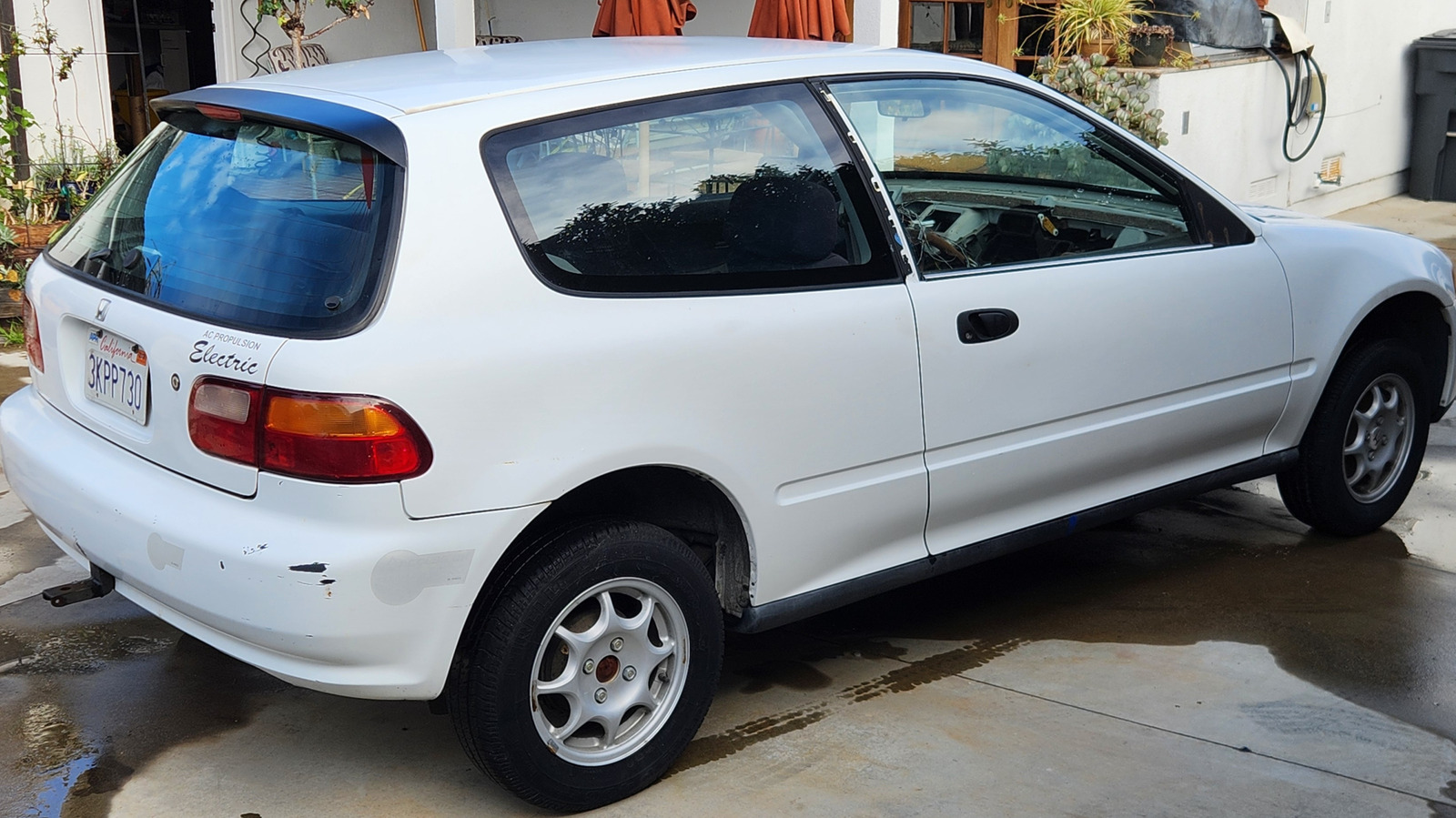
Tom Gage is the one-time CEO of a company you probably don’t remember, called AC Propulsion. However, that firm was one of the progenitors of EVs and, by extension, Tesla. Gage is also the one-time owner of this 1994 Honda Civic. This past weekend he sold it, and we should explain why that’s important.
See, underneath its aged sheet metal, it wasn’t a Civic at all, but more of a science experiment. It has no tailpipe because Gage’s partner, AC Propulsion co-founder Alan Cocconi, gutted the little hatchback in 1994 to fill with lead-acid bricks and convert the Civic into a proof-of-concept electric car that led to the rise of Tesla. The Tesla link is that AC Propulsion used the Civic to try out systems that would later debut on the company’s 1998 tzero electric Roadster. That car looked cooler, but had the same tech that powered the electric Honda. And it’s that technology that Tesla eventually licensed in 2004 and that ended up featuring in the original Tesla Roadster in 2008.
We interviewed Gage, who explained that it wasn’t electric propulsion (at first) that attracted Tesla co-founder Martin Eberhard to EVs — and, eventually, Elon Musk. It was actually its sexy shape, which was just a kit car called the Piontek Sportech. “I mean, that was exactly the reason we built the tzero in the first place,” Gage explains. “EVs still had this golf cart image, and so even with lead-acid batteries, the tzero would be zero to 60 in the four-second range.” This is funny because, actually, the Honda was just as fast. The tale of how AC Propulsion went from gutting Civics to making electric Scions and, eventually, helping spawn the iconic Tesla Roadster, is fascinating. It even includes a bit of spying, too.
How this lead-acid 1994 Civic EV was ahead of its time
Some of Cocconi’s engineering that made it into this 1994 Honda Civic was way ahead of its time. For instance, Gage says Cocconi devised a module that could produce AC-to-DC (and vice-versa) power flow. “When you were driving, [it] could take the DC current from the battery and convert it to high-frequency AC to run the motor. And when you weren’t driving, and you plugged it in, the same inverter components would convert the AC from the grid into DC to charge the battery.”
Modern EVs have this capability, but even today, something Cocconi worked on isn’t ubiquitous — feeding power from the EV back to your home or to the grid. AC Propulsion cars were eventually capable of that at up to 20 kilowatts, while the 2027 Ford Fathom will be able to do this without a wall inverter at 10 kW.
According to Gage, the Civic had the first iteration of the 200-horsepower system, which the firm called a power electronics unit because it was more than just the motor and inverter. It contained that, as well as the charger, and the ability to push out a 12-volt DC power supply, which the Civic (or any car) needs since all of its components run on 12 volts.
Reluctant hybrid pioneers
Even back in the 1990s, AC Propulsion was looking for solutions that still bedevil carmakers today. For instance, how do you get reasonable all-electric range and fight battery weight simultaneously? At first, because the company was working with lead-acid batteries, they were stuck with limited range, and those batteries were far heavier than later lithium cells. Gage says that with batteries aboard, the Civic exceeded the gross vehicle limit of what the chassis was designed for, with the batteries alone weighing 1,200 pounds.
Fixing this required fitting a trailer with a gas engine aboard to operate as a range-extending generator, which topped up the batteries while driving. This created a series hybrid rather than a parallel hybrid, and the difference is that series hybrids only run their gas motors as generators — the engines don’t power the wheels. Hence, putting the motor on a trailer works just fine. “We had several generations,” Gage laughed. “We had some kind of a Generac standard generator, which we modified in various ways, but the exhaust was really stinky and [it] didn’t have that much power.”
They eventually turned to Kawasaki, using the engine from the Ninja 250, which cranked at 11,000 rpm. “It was a little noisy,” Gage quips. But it enabled the little Honda to get a remarkable 81 mpg. Later, AC Propulsion would adopt lithium-ion laptop batteries, and finally they could ditch needing to tow a gasoline engine to power an electric motor.
The battery breakthrough
AC Propulsion went from their lead-acid-battery Civic in 1994 to the tzero in 1998. It initially also ran on lead-acid batteries. That problem was eventually solved in 2003, when AC Propulsion adopted lithium-ion batteries for the tzero. And this was huge for performance and range. “That was what drew the attention of the founders of Tesla,” Gage says, referring to Tesla co-founder Martin Eberhard. “Just getting the lithium-ion batteries, the tzero went from 80 to a 100-mile range to a 300-mile range with a 600-pound weight reduction.”
Eberhard became an early investor in AC Propulsion and wanted to purchase one of the tzeros. But mass production, according to Gage, was out of the question, since the cars would have to sell for $220,000, and AC Propulsion told Eberhard they were losing $100,000 on every tzero they made. But Eberhard still had sports car dreams, which turned out to be fortunate for him. Around this time, Gage and Cocconi were trying to attract another investor, a man named Elon Musk. They didn’t want Musk’s money to make more tzeros, but to transform the future of transportation.
“What the world really needs is a low-cost, high-utility vehicle,” Gage says. But Musk, like Eberhard, didn’t care about cars for the masses. “It was too mundane for him,” Gage recalls. “He wanted to do something like the tzero. So I introduced him to Martin [Eberhard].” That’s how Tesla got started. From 2004, rather than outright build Teslas, AC Propulsion would license its tzero technology to the startup. This would later help spawn the 2008 Tesla Roadster — the predecessor to the new Roadster that’s boring and doesn’t really fly, according to your takes.
Of Scions and Leafs
Gage and Cocconi’s next big idea wouldn’t turn out to be anything as consequential as they’d hoped. They were converting Scion xBs into EVs, and AC Propulsion called that car the eBox. Gage explains they chose the Scion because it was practical and cheap. “It’s got some of the best rear seat ingress and egress of any car ever built, in my opinion. Maybe that’s a small thing, but you know, it was just a super utilitarian design.” As Gage also explains, that Scion seemed “iconoclastic.” And there was the matter of a tall-riding box, the better for stuffing batteries aboard. Unfortunately, the second-generation xB was a lot heavier than the first. “We realized the importance of lightweight to make the end product as good as it could be,” he says, so they explored working with Nissan instead.
Nissan did oblige — but with an ulterior motive, according to Gage. “They ended up sending a bunch of engineers over several times to drive the eBox and look at it. We thought we were trying to work a deal with them where they would provide us with rolling chassis or some kind of supply arrangement.” But that’s not what Gage suspects was actually happening. “Turns out, what they were really doing was scoping out what we were doing,” because Nissan was researching its own EV. “Then a year or two later, they came out with the Leaf.” The Leaf is still on the market, and Nissan recently came out with a Leaf Nismo.
The Civic is going to a good home
There’s a kicker to this story. Gage worked in the battery division of AC Propulsion until 2011, and he noticed that the Civic was just gathering dust. So he bought it for $100. “I forget when they stopped driving it, but it was just parked in the back lot. I offered them 100 bucks for it, and they sold it.” Not that it was a gem, or even running, Gage explains. “One of the employees at one point asked if he could turn it into a race car, and he started to tear it apart, but that’s about as far as he got.”
Gage says that this employee’s ambitious plan included rewiring it and making a different adapter for the battery pack to switch from lead-acid to lithium-ion batteries. “I just know they wanted to get rid of it, and so I took it on, and I’ve been storing it ever since here,” meaning at his house in Southern California. He thought about switching over from lead-acid to lithium-ion, which he figured would yield a car with up to 600 miles of range. He also thought of just going for broke with, “Super high-power lithium batteries, and then have a bit of a rocket ship, you know, because it would be much lighter than the average EV would and still have 200 horsepower.”
Whether that’s the Civic’s destiny is unclear. But the good news is that the buyer already owns an AC Propulsion car, a Honda CRX the company converted in the early ’90s. Gage called him a “worthy buyer.” To this, we can only add that we hope there’s another chapter to this story when the Civic is once again burning rubber under electric power.
