
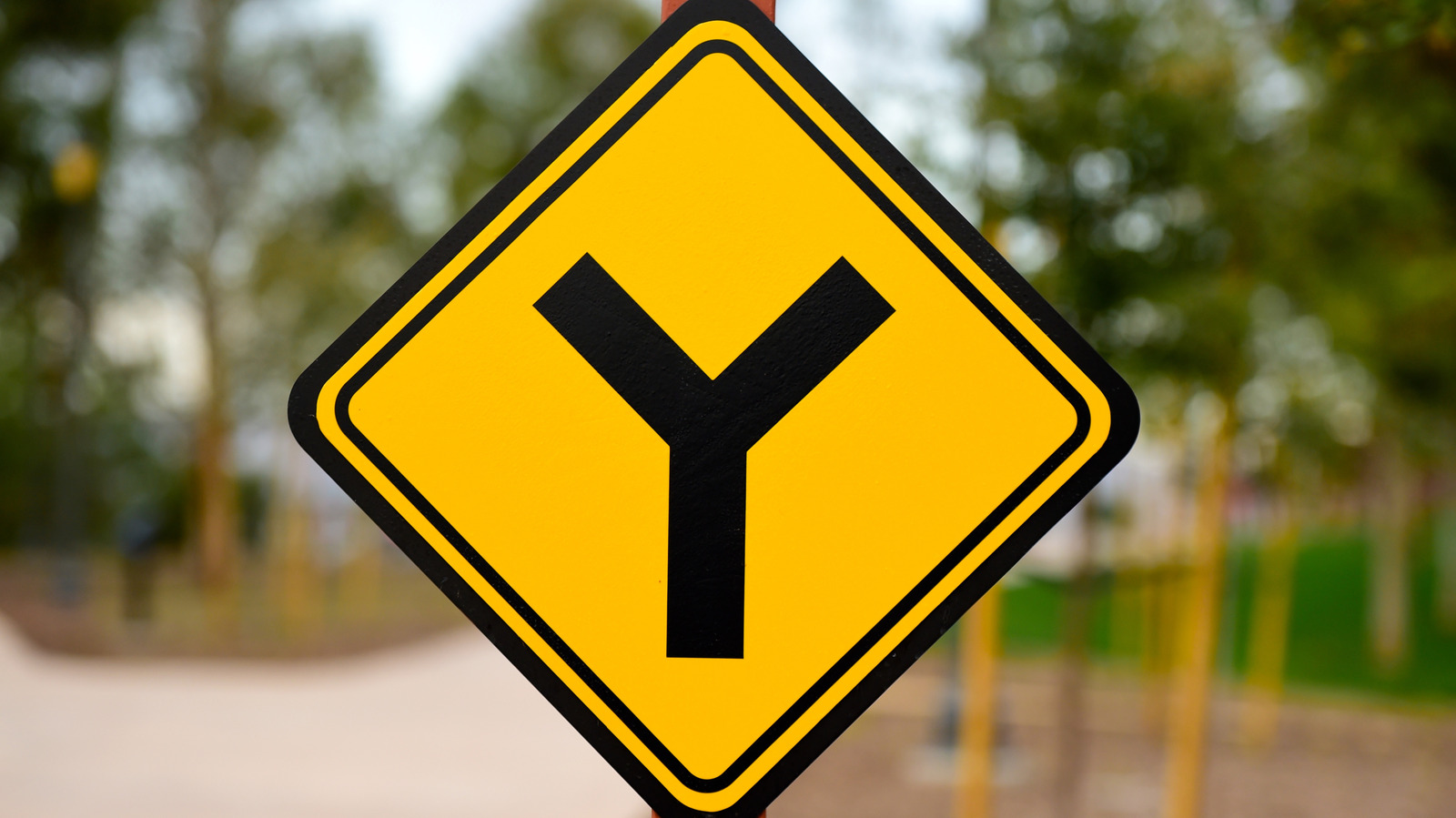
We have covered all manner of weird road signs on Jalopnik before, including some seriously goofy ones. While oddities from around the globe are fun to explore and explain, it is a little more relevant to touch on road signs that crop up on U.S. soil. Some of these will no doubt be familiar, but others may not, so there is good reason to delve into them and provide a quick explainer. The black “Y” sign was the one that initially piqued our interest, which, by the way, highlights that a Y-shaped intersection is to be found up ahead. That led us to look at other weird letter- and symbol-focused road signs drivers may come across.
The obvious candidates are “P” for parking areas and “H” that marks hospitals, which are universally understood, but throughout this article, we will also explore what those weird “T” or upturned “U” signs mean, in addition to winding “S” and plus-symbol signs. That includes where drivers are most likely to find them and how best to react when they do. Listed in no particular order, here are our picks of eight letter- or symbol-focused road signs that we thought are worth exploring in a bit more detail.
This sign warns of a Y-shaped intersection
As already explained briefly above, a sign that depicts a capitalized “Y” is there to let drivers know of a Y-shaped three-way intersection or a forked road ahead. The sign will typically be a diamond shape with a yellow background, which means it’s a simple warning sign alerting drivers that the road splits. The choices of where to go are obvious — either left or right — but what might be less obvious is how the right of way is determined in a three-way intersection that isn’t controlled by any other signs.
The general rule is that drivers must yield to the car on the right. Then there’s always the first-to-arrive rule, which works as you would intend — the first to arrive at the split goes first. Of course, some drivers will assume right of way when it is not deserved, or perhaps they just do not see the other car(s). In such instances, it’s best to yield to the other vehicle even if you believe you should have the right of way to ensure everyone gets past the intersection without incident.
When a road splits like this, it pays to be especially cautious. Drivers may attempt to dart from one lane to the next when correcting a last-minute wrong decision, plus motorbikes or cyclists could be hiding in your blind spots, so try to ensure you have sufficient space around you if possible. The NHTSA highlights that roughly one third of all traffic fatalities occur at signposted intersections, so doubling down on cautiousness here is never a bad idea, no matter how simple it may first appear.
Prepare to stop for a T-shaped intersection when seeing this sign
Surprise surprise, the letter “T” on a road sign warns of a T-shaped intersection — we would hope that you managed to work that one out. The road you are traveling on is about to end and merge with another. Once again, this is a classic warning sign finished in a yellow and black colorway, on a diamond-shaped sign that lets drivers know something’s coming up and they will have to act accordingly.
In this instance, drivers must yield to traffic on the intersecting road — they don’t have the right of way here — before heading either left or right. There will usually be a stop or yield sign prior to the intersection itself, and to avoid any frustrating bumps with other drivers making late decisions, it’s best to get into the required lane early rather than last-minute. Thankfully, of the deadliest intersections on U.S. roads, not many are T-shaped, but the same rules as above apply here. Give yourself space, keep an eye on your blind spots, and don’t rush. Oh, and don’t forget to use your turn signals either, even if you are in a dedicated turn lane.
This simple cross symbol is an easy one to guess
Again, we won’t be handing out prizes to anyone who is able to correctly guess this one. A cross or “plus” symbol indicates that a crossroad is coming up, and just like the other aforementioned sign, this too will be depicted on a black and yellow diamond-shaped warning sign. Here, traffic can and likely will be coming from all directions, so it’s imperative to take the time that’s needed and approach it with care. Be aware that drivers on the opposite leg might try to cross ahead of you as you pull out, and be sure to check traffic from both left and right directions. As always, make sure to follow the instructions depicted on any regulatory signs posted in your direction, as these might detail give-way instructions.
There is a good case to make here in favor of the roundabout. In many ways, it is a far better design than the traditional intersection, with fewer conflict points, no left-turns across the flow of traffic, and lower speeds. Roundabouts might seem perplexing to some, but according to data from the Federal Highway Administration, they have been proven to reduce injury and fatal crashes by 76% and 90%, respectively, plus they are far more time-efficient than traffic signals, so perhaps road users ought to just get used to them.
Winding S-shaped arrow signs indicate a Miata is likely nearby
OK, that’s not strictly true. This sign, which isn’t an “S” at all — it’s just a winding arrow — signifies that a winding road is up around. In other words, the natural habitat for a Miata owner who’s looking for some engaging roads to make the most of their drop-top weekend car. Of course, the sign isn’t actually there to tell drivers that the road is a great place to go hooning. Instead, it lets them know the road ahead has several curves one after another and that they should approach that section of road with some caution.
In fact, these “S” signs will frequently be accompanied by another advisory speed sign that suggests the maximum safe speed for the section. Drivers would be wise to pay attention to these speeds, as around 25% of all fatal road incidents happen on a curved section of road, with common causes being cars either drifting off into trees, rocks, or other fixed objects, or indeed drifting across the center of the road and causing a head-on collision with other traffic.
An upturned ‘U’ on a sign dictates whether drivers can or cannot perform a U-turn
Anyone who can’t figure this one out should probably start taking notes here. An upturned U-shaped arrow crossed out in red, of course, means that U-turns are not permitted. Drivers should continue on, take a left or right turn if available, and find another suitable route. Exceptions will not be made for those in classic red-and-white Gran Torinos.
This is the first sign featured on our list that strays from that typical yellow and black warning sign colorway. Instead, this is a rectangular regulatory sign with a white background. These signs can crop up just about anywhere, but they can commonly be spotted in business districts, on narrow streets, or busier stretches of the nation’s roads, such as on multi-lane highways and freeways.
For those who may question the legality of U-turns when this sign isn’t present, drivers can usually perform such a move in these circumstances: They should be in the leftmost or center-left lane, signalling their intention, and keeping an eye out for traffic as per any other manoeuvre.
This sign is a hybrid of the letters F and E
A sideways “T” sign indicates that a side road is coming up. Depending on which way the T is oriented, the sign highlights whether the side road is on the right or the left. If the sign instead looks like an F or an E, but with an extended top or bottom, this means that two side roads are coming up on the right-hand side.
Specifically, this sign will appear when the side roads on the right are particularly close to one another. The hazard this poses to drivers on the major road is quite obvious; they should be wary of traffic entering from the right, and should be prepared to slow down. The sign itself is a typical diamond-shaped yellow-and-black warning sign, which does not indicate right of way. Typically, those on the major road will have the right of way, while those on the indicated side roads will have to yield to traffic on the major road.
This O-shaped sign notifies drivers of an upcoming roundabout
The sign for a roundabout shows three arrows forming a circle, and once again, it will be a yellow-and-black diamond-shaped warning sign. Roundabouts always run in a counter-clockwise direction in North America. They can have numerous lanes and are an alternative to crossroads. Here, the right of way rules are simple and uniform: Drivers must always give way to traffic on the left — in other words, the cars that are already on the roundabout.
Getting the right lane is crucial for avoiding accidents; the leftmost lane is used for turning left, whereas the rightmost lanes are used for turning right, and both can be used for going straight on. These are the rules on multi-lane roundabouts unless signposted otherwise — this way, traffic in either lane does not cross unnecessarily.
As for whether drivers need to use turn signals on a roundabout or not, the answer is yes. It’s never a bad idea to let other drivers know where you are going; even if you are comfortable in your own abilities to get across safely, it’s best practice to help other motorists out by indicating to them your next intended move.
