

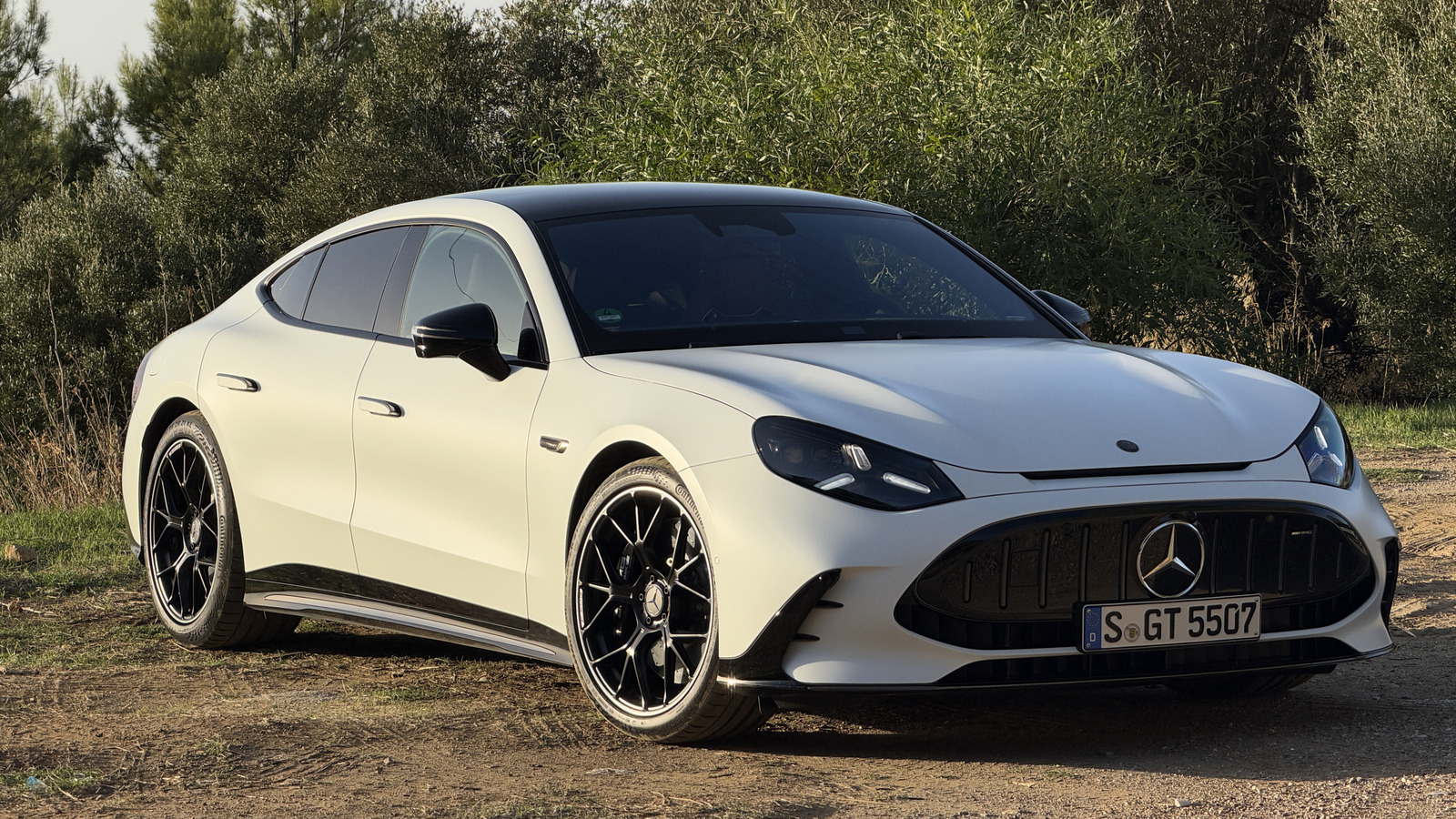
If that was all and the review ended there, I would say the AMG GT is one of the best EVs (or any sort of car) on the market. Once you try the AMGFORCE Sport+ mode with its V8 noises and shifts, though, you won’t want to drive it in any other mode again. In fact, you probably won’t want to ever stop driving the GT, and no other EV will scratch the same itch. It’s hard to think of the right words to describe it. I definitely wouldn’t call it “fake”, and “simulated” doesn’t feel right either. Saying the noises are “synthesized” is probably the way to go, but really it doesn’t matter at all. Who cares that the sounds and shifts are not “real” when the end result is this absurdly good?
AMG recorded more than 1,600 sound files of the previous-gen GT R’s twin-turbo 4.0-liter V8, capturing every situation from every possible angle, and they’re mixed in real-time to match driver inputs and what the powertrain is doing. That means you’re never hearing the same noises twice, and everything feels unique and organic to how you’re driving the car. The same goes for how it “shifts” when you leave the car to its own devices, though you of course can and should use the paddles to shift, too. Put anyone into the GT as either a passenger or a driver without telling them what’s powering the car, and they’ll all think there’s actually a V8 under the hood. It adds a ton of engagement and sensation to an already engaging drive, eliciting feelings of sheer joy and excitement.
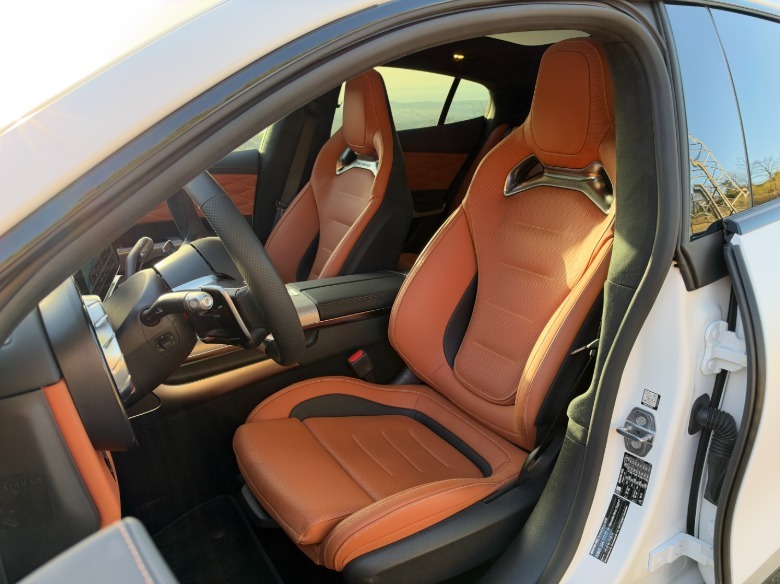
First of all, it’s loud, but not in a way that’s obnoxious or too much. If you switch into AMGForce Sport+ when the car is stopped it’ll burst to life sounding just like the real V8 on startup, but it’s much funnier if you change the drive mode at speed, since the car will kick itself into a low gear with the revs up pretty high, resulting in a hilariously good sound. Keep the car in Sport+ around town and it emits wonderful burbles, while at cruising speeds it fades into the background and shifts smoothly like a V8 would. Drop a few gears and start driving more energetically, though, and it gets really gnarly. As my drive partner and friend of Jalopnik, Roberto Baldwin, points out, the placement of the speakers and the rumbling exciters in the seats make it sound like the car is mid-engined, or that there are big side-exit exhaust right underneath us. It roars under acceleration, utters pops and bangs on “overrun,” barks when I shift. Nothing about the noises sound artificial, unnatural or repetitive.
 Daniel Golson/Jalopnik
It’s just freakin’ awesome, and after just a few minutes you might totally forget that you’re in an EV at all. Except that even in this mode, with shifts that come with an authentic cut in torque, the GT’s acceleration still gives the tunnel-vision feeling you’ll only get from an EV. Engineers tell me that the GT is just as quick to accelerate and fast around a track with the shifts on as it would be with them turned off, and in fact the aural and physical feedback will probably help you post even better lap times than you otherwise would.
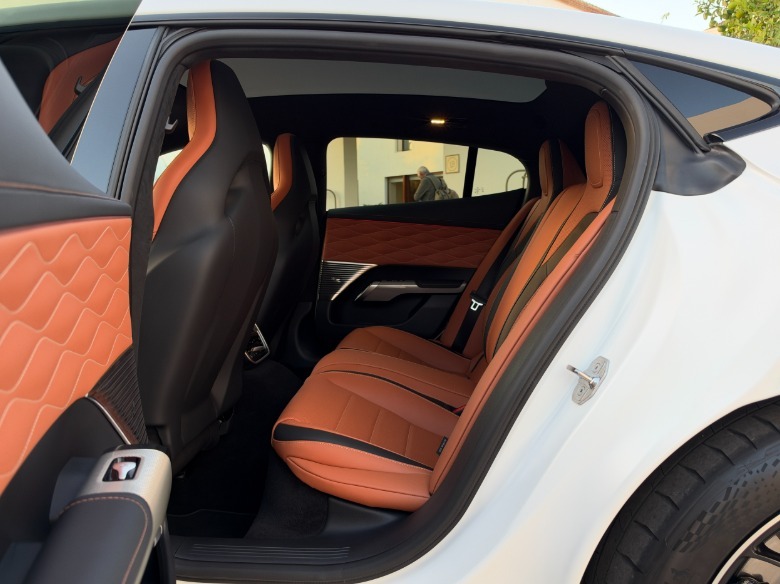
Crack off shifts with the paddles, and you’d swear there’s a real DCT transmission in here. There’s an urgency and gut punch quality to the upshifts, and downshifts can be quite forceful too. Using the vibrators in the seats, the car mimics the mechanical clunks and thumps you’d feel in an ICE car’s drivetrain. When in S+ you can’t mess with the regen, which is set to the minimum level, but downshifting does aid in deceleration, like strong engine braking. It will “rev” to 7,200 rpm, and the car will hold gears for pretty long and upshift right at redline.
You can hear the sounds outside the car as well, and it’s loud enough that we can hear GTs driving on track from pretty far away. If you really want to be obnoxious you can park the car, put it in neutral and rev it, putting any nearby Dodge Charger Daytonas to shame. Keep your foot pinned to the floor and it will bounce off the redline seemingly indefinitely – we wouldn’t know, because after about ten seconds of doing it for a TikTok, a few Germans walked over to ask us to please shut the hell up.
 Daniel Golson/Jalopnik
The GT’s Boost function is also at its best in S+, though it’s available in all drive modes. Pull both paddles at once and it instantly activates, providing maximum power for a long time. Like, a really long time. Most cars that offer a Boost do so for 10, 15, maybe 20 seconds, and sometimes you have to wait before activating it again. That’s one of the big benefits of the GT’s powertrain – in the GT55 the boost lasts for 55 seconds while in the GT63 it’ll stay on for 63 seconds, and as soon as it finishes or you manually turn it off, you can immediately activate it again. One AMG representative told me the boost could theoretically last forever, and they needed to come up with an arbitrary time limit. It is actually nice to have it last so long, like if you’re coming up on a particularly complex and lengthy set of switchbacks. Turning on the Boost always comes with louder sounds and a countdown timer in the gauge cluster, but with the V8 activated it’s a lot more dramatic. The engine noises sound like they get 25% louder, and the shifts feel even more aggressive. It rules.
OK, sure, you might try the AMGFORCE mode and still come out hating the sounds and shifts, even though I can’t imagine not loving it. At least you can just switch into one of the other drive modes and it all turns off. It is really nice to be able to go back into Comfort once I’m on the freeway or get stuck behind slow-moving traffic on a twisty road, the car immediately settling back down into a silent, swift electric cruiser. Our group of journalists was unanimous about one thing during dinner conversations with AMG execs and engineers, though: We want to be able to turn on all the AMGFORCE stuff in all modes from Comfort to Race, not just be restricted to Sport+. It really is that compelling, and that’s something Mercedes could easily change with an over-the-air software update.
