

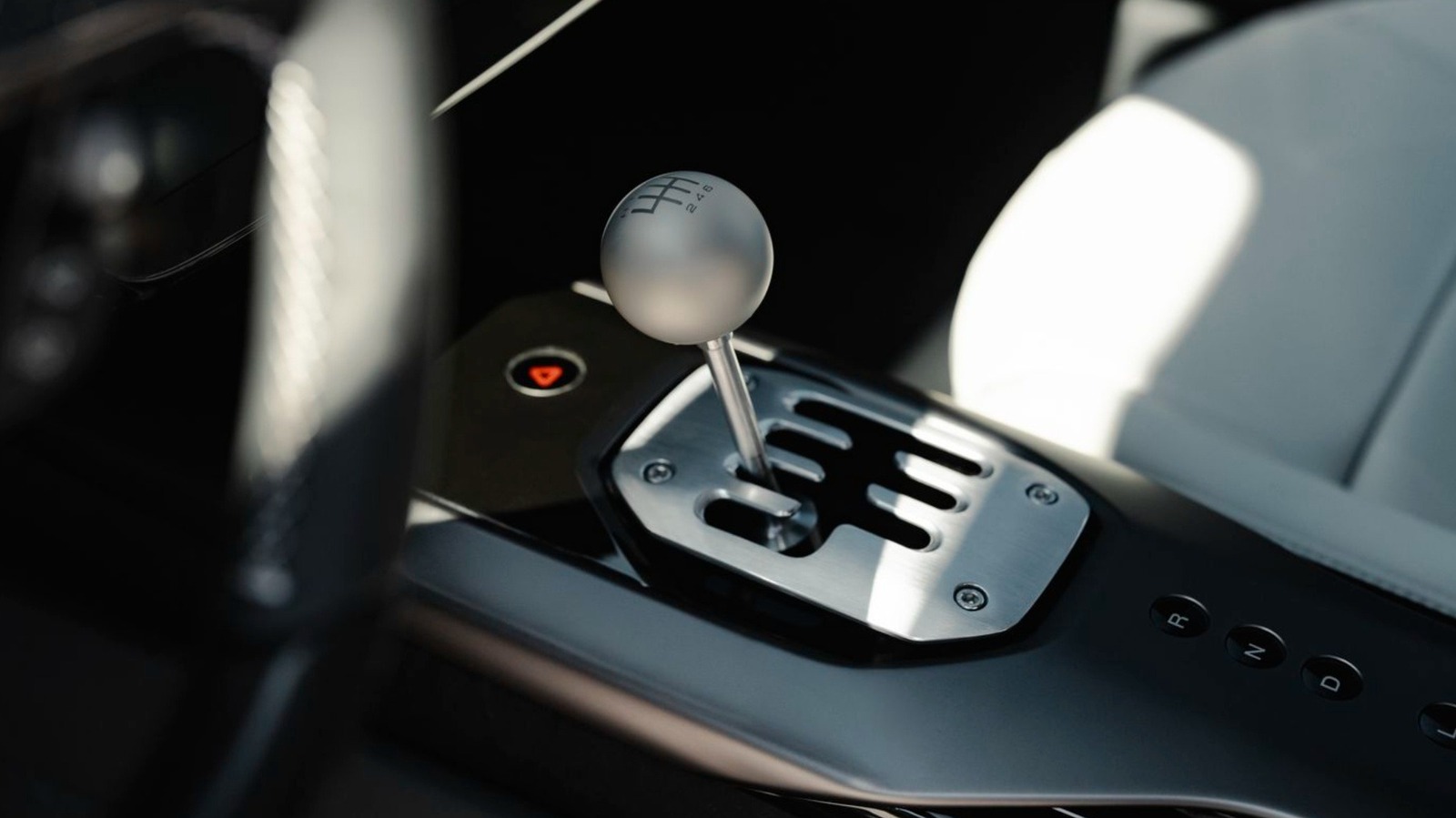
Sometimes even an exotic carmaker’s answer to a challenge might say something about future cars for the proletariat. Most of us probably can’t even afford a replacement shift knob on the 2027 $677,600 Ferrari 12Cilindri Manuale, but how Ferrari and Porsche are adapting their automatics to fit manual transmissions could one day portend stick-shifts for us all. Here’s the reason to even posit this: Carmakers want a cheaper way to build hybrids, EVs, and gas cars on the same platform and on the same assembly line. Adding or subtracting parts will make that too costly — which may result in them just ditching any manual effort, if that’s the only solution.
Now that you understand the why of this reporting, we’ll also acknowledge why some readers are freaking out about the fact that the 12Cilindri Manuale will simulate the experience of shifting. It’s not a conventional manual, and we’ll explain how it works in greater depth, but the gist is that Ferrari’s linking an electric stalk and faux clutch pedal to an eight-speed dual-clutch drivetrain. It’s as real (or fake) as paddle shifters, just via a dongle and pedal.
On the other hand, Porsche’s stick-shift retrofit is a hack of their seven-speed PDK, which stands for Porsche dual clutch– or Doppelkupplung. It debuted on the 2020 Porsche 911 Carrera S Manual, dubbed MECOSA, which is Porsche-speak for MEchanically COnverted Shift Actuator, and is an entirely mechanical retrofit, featuring a seven-speed gated shifter and third pedal. But which is better? And which foreshadows a future joystick for the masses?
From manu-matic to MECOSA
Automatics have been steadily growing in popularity since their debut in 1939, and according to the U.S. Department of Energy, by 2022, 99% of all new cars sold offered automatics. Standard automatics further evolved in 1987, with the introduction of the gearless CVT — a transmission Jalopnik readers hate in a way that borders on irrational.
The alternative? Something like Porsche’s PDK, which is a dual-clutch manu-matic. Porsche began experimenting with the PDK in the 1980s. It debuted in racing in the 1986 962, and by 2008 you could get a PDK in a 911, which allowed drivers to shift using paddles for extra engagement and provided benefits such as engine braking. But it does more than just ditch the third pedal and shifter — the PDK in the 2020 Carrera S shifts at least 200% faster than a human can shift in the MECOSA, according to Car and Driver.
Despite that, at least 20% of Porsche 911 customers in America opt for a genuine manual, hence the MECOSA. Mind you, this is still a PDK underneath, and since its gears are arranged for a computer to actuate, not a human, they’re not in any sane order. Instead, the pattern looks like this, starting from the top left of the gate: R,2,3,1,6,4,5,7. To translate the driver’s inputs into proper shifts behind the scenes, MECOSA activates a jangle of cables and shafts so that each push or pull of the shifter engages the correct gear.
It’s a solution that would make MacGyver proud. It is also not one Porsche is sticking with. The Stuttgart giant isn’t abandoning its 911 customers clamoring for a manual; but now, you can get a Carrera S with a standard six-speed transmission, rather than a seven-speed with a Rube Goldberg machine tacked on.
The modern Ferrari manual isn’t a manual
Like Porsche, Ferrari’s Manuale has a gated shifter instead of paddles, and it gains a third pedal on the floor. The transmission is physically identical to that of the paddle-shift version. Ferrari’s legerdemain is to delete the paddles, insert a shift knob, and add a clutch pedal with sprung feedback. Now it feels as if your left foot is encountering a clutch spring as your ankle hinges, and Ferrari has created similar tricks in the gated shifter itself to simulate the feeling of gear shifts. Behind the scenes, however, sensors track both inputs. Your motions tell the car’s computers what to do, which is identical to what happens when you pilot the 12Cilindri minus the Manuale. Except, in this one, it’s possible to encounter rough shifts and even to stall the Manuale.
Keep in mind, this V12 Ferrari is carrying two extra gears you cannot joystick into. This is still actually an eight-speed DCT, not a six-speed manual, so it can also be driven like an automatic. Tap the D button on the console and the car will shift itself, and you have access to seventh and eighth gear — for lower-rpm Autobahn sprints, say.
You might cry in your pasta fagioli that Ferrari should only sell its 819-horsepower, 9,250-rpm V12 with a genuine-article manual gearbox, but Ferrari will only make 1,499 units of the Manuale. For that take rate, there was no way they were going to retrofit a manual gearbox, if for no other reason than this: It probably saves them millions on not having to develop a separate manual transmission 12Cilindri or certify two different transmissions for regulators.
The future, courtesy of Ferrari, Hyundai, and Porsche
Right now, the electric Porsche Taycan gets an E-Shift option. The Hyundai Ioniq 5 N offers something similar. E-Shift uses software to simulate gear changes, including simulating step-changes in acceleration, and adding a soundtrack, just like the Hyundai. Porsche copied patterns from their PDK, including adding a deceleration function during downshifts. But neither brand adds a third pedal — yet.
But the future for Porsche probably isn’t either E-Shift or conventional manuals, since Porsche recently published two patents that seem to follow in Ferrari’s footsteps, creating simulated shifting that could function in electric, hybrid, and gas cars. The patents also mention a fake clutch pedal, just like the one Ferrari is using, and the ability to shift sequentially, like the PDK. Porsche also describes a system that uses electrical components to provide resistance and something like progressive feel to gear swaps, to enliven driver engagement.
Considering what we found in our review of the Hyundai Ioniq 5 N, with its fake shifts and sounds, it only makes sense that blurring slushbox convenience and manual control at the flip of a switch could make any machine more entertaining — or more relaxing. Porsche’s patents could also potentially smoke Ferrari’s hack, because they apply regardless of powertrain.
This innovation could also get to non-Porsche EVs and hybrids via licensing. After all, Porsche isn’t doing great financially. Ditto, parent company, Volkswagen — partly thanks to Porsche’s struggles. A little trademark cash could definitely help that picture. And, just maybe, save the manuals for the rest of us.
