

Freeways are to people what arteries are to red blood cells. Most freeways consist of three or four lanes of synchronized traffic flow (or collective halt), but have you ever wondered what the world record is for the highest number of lanes on a freeway? The obvious choice would be the Katy Freeway on I-10 just west of Houston, which has no fewer than 26 traffic lanes spread across both directions at its widest. However, that number also includes feeder roads that don’t actually form part of the I-10, so it’s often argued that the “true” number is actually 18.
If that’s the case, a few other massive highways may indeed lay claim to Katy’s title as the highest-lane highway in the world. Canada, for instance, has an 18-lane road approaching one of its airports, while Burma’s capital city has a section with up to 20 lanes. However, perhaps the biggest threats sit halfway across the globe in China. These include a special section of the G4 Beijing–Hong Kong-Macau Expressway and the Hefei–Nanjing Expressway, the latter of which can open up to as many as 36 separate lanes — but with one very important caveat. Let’s take a look at some of the highest-lane freeways in the world and how they compare before crowning the winner.
How legitimate is the G4’s claim?
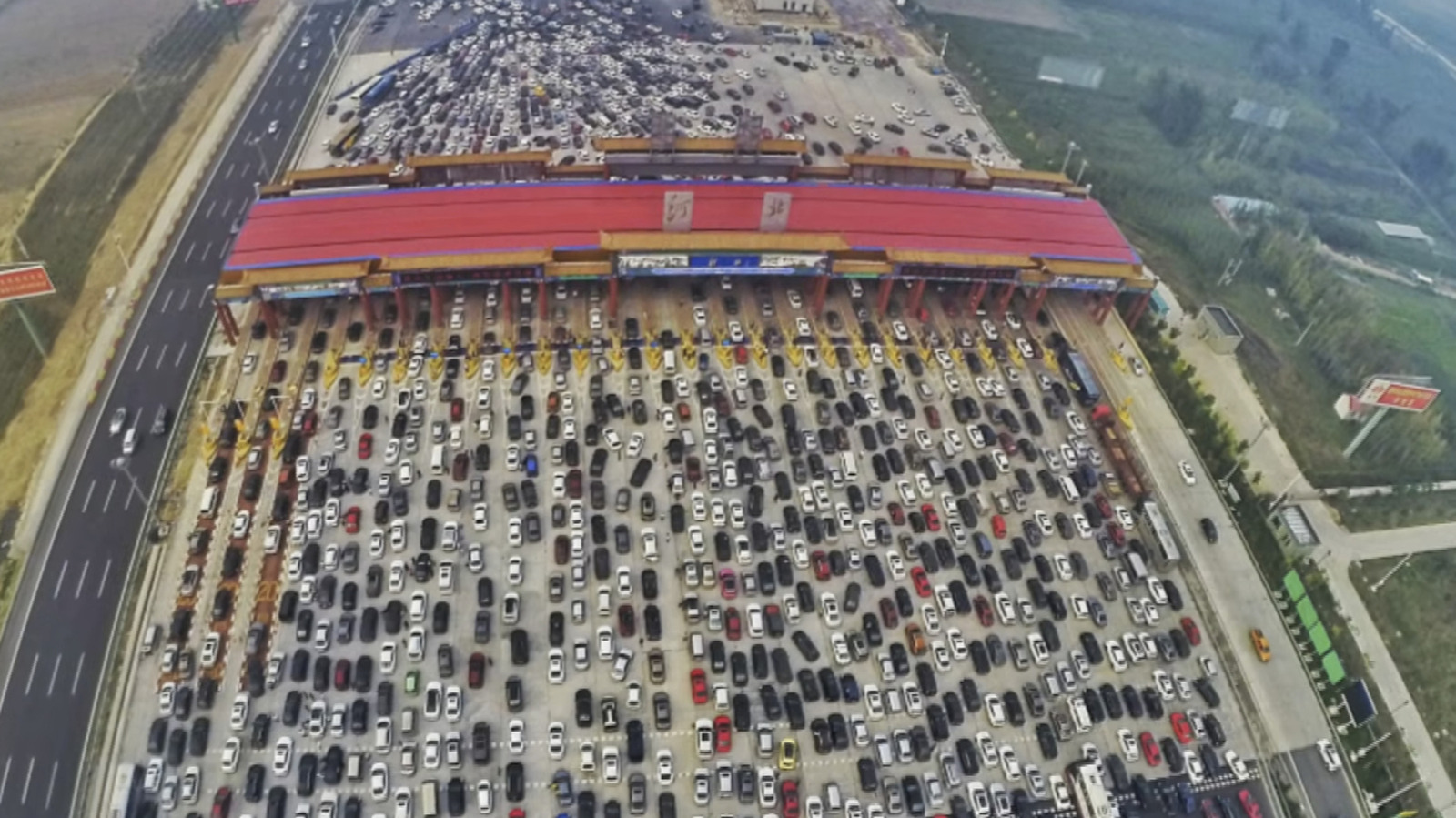
See, this is where things get tricky. While Katy has at least 18 lanes of moving traffic at its widest, both the G4’s 25-lane and the Hefei–Nanjing Expressway’s 36-lane sections are actually toll crossings. For example, the G4’s 25-lane Zhuozhou Toll Gate section only starts about 710 yards before the tollbooths and ends about a quarter-mile after them. Most of its 1,412-mile road network — long, but not quite enough to match the world’s longest highways — is actually just four lanes in each direction. The same goes for Hefei–Nanjing Expressway, which funnels back to four lanes beyond the 36-lane Wuzhuang Toll Gate.
That’s the key differentiator here. By comparison, Katy’s 18 lanes consist of 12 passenger car lanes and a maximum of six for high-occupancy vehicles (HOVs), and stretches for an estimated length of 12 miles. Of course, the definition for how long a stretch of road would need to be to qualify is subjective, but what isn’t subjective is the fact that one has fast-moving traffic, and the others don’t. In fact, back in 2015, huge delays at the G4’s Zhuozhou crossing during China’s Golden Week celebrations, with drivers stacked next to each other, gave rise to false reports that the G4 had as many as 50 lanes. Still, calling a slow-moving toll plaza a highway is a stretch. But what about other highways with 18+ lanes?
What other freeways have lots of lanes?
If you thought Germany’s Autobahn, the only highway in the world with no speed limit, staked a claim, then you’d be quite wrong. Despite its infamous reputation, the Autobahn never goes above four lanes in each direction. The 20-lane section of Yaza Htarni Road in Naypyidaw, Burma, does count, though. It was brought to widespread attention during the “Top Gear: Burma Special” episode, where James, Jeremy, and Richard were astonished at just how wide (and empty) it was. However, it only extends for about 2.5 miles (4 kilometers); it’s not an actual highway, and it’s mostly deserted.
Then there’s the King’s Highway 401 in Ontario, which matches the Katy Freeway’s 18 lanes as it approaches the Pearson International Airport. This sounds particularly useful given that the highway can sometimes see up to 500,000 vehicles over the course of a day. However, at the end of the day, none of these roads really match Katy at its widest, where feeder and carpool lanes join it to form as many as 26 lanes of fast-moving traffic.
