

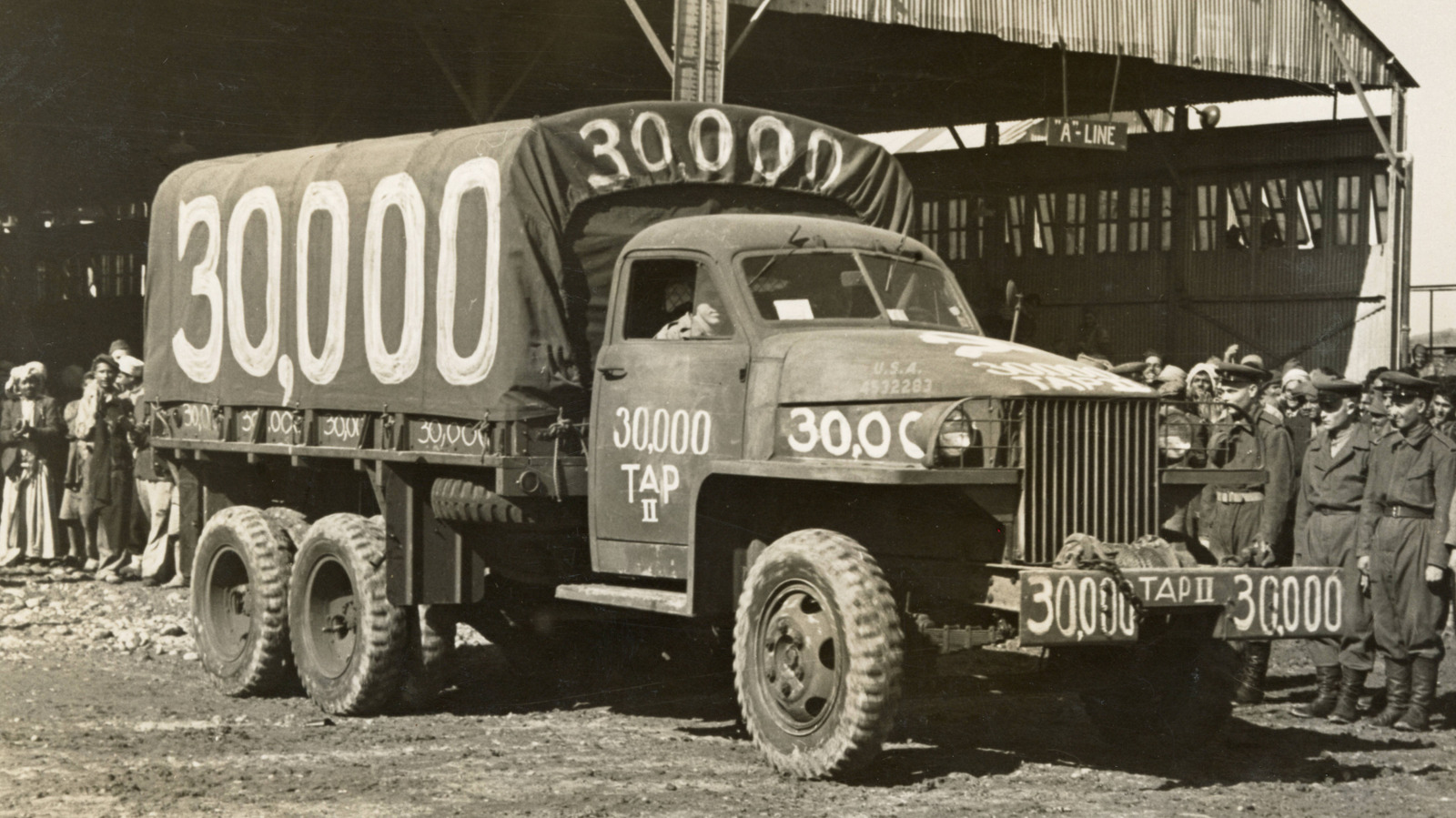
Imagine a situation where the United States is supplying Russia with military trucks. Now, imagine those same trucks being assembled in Iran. Using today’s geopolitical climate as a basis, such a scenario sounds ridiculous. However, during World War II, that actually happened.
The brand behind the multicultural program was Studebaker — one of America’s most popular marques during the early 20th century. Studebaker began shipping complete knockdown kits of its then-new US6 2½-ton 6×6 truck to the Persian Corridor supply route, and assembly took place at both the Andimeshk and Khorramshahr plants in Iran. Once the trucks were built, they were promptly driven north to the Soviet Union’s Red Army for deployment among its forces.
The Soviets loved the American Studebaker, as it could handle just about everything the brutal Eastern Front could throw at it. The US6 carried an old-school ladder-frame chassis with enough room for troops, gear, and anything in between. All told, it’s reported that tens of thousands of them were assembled at the two Iranian plants, and even Soviet dictator Joseph Stalin took notice of the US6’s prowess on the battlefield.
The Lend-Lease Act gave the Soviets access to the American Studebaker US6
Around 1939, the U.S. was interested in developing a new 6×6 truck that could handle virtually anything the military could throw at it. Studebaker was one of three automakers that sent design proposals to the Army Ordnance Corps, and its design was accepted. Production of the US6 began in 1941. Almost immediately, the United States saw an opportunity to help with the war effort in Europe prior to U.S. involvement, while also making some much-needed cash along the way, thanks to the Lend-Lease Act of 1941.
As part of the new law, Studebaker began shipping complete knockdown kits of its US6 to two Iranian-based assembly plants. Andimeshk became the first, with assembly commencing in March 1942. Assembly began in Khorrmshahr in January 1943. The U.S. Military then assumed control of both plants from General Motors in July 1943, but retained most of the local employees.
Once assembled, the finished US6 models would be given to the Red Army and driven north across the border between Iran and the Soviet Union to join the fight against the Germans. Soviet troops quickly took a liking to the trucks, and began to affectionately refer to them as “Studer”, or “Студер” in Cyrillic.
The Soviets found a slew of alternate uses for the US6 besides serving as a troop or cargo transport vehicle. One of its most popular unconventional assignments was serving as a mobile platform for the Red Army’s Katyusha rocket launchers. It was also given the task of towing heavy anti-tank weaponry. In fact, the US6 made such a positive impact on the Red Army’s war efforts that Stalin personally penned a letter to Studebaker, thanking the brand for designing such a rugged military vehicle.
The King of Roads left its mark on the Soviet Union
As one could imagine, earning the favor of Stalin himself wasn’t an easy task, meaning the US6 had to be tough. The truck took advantage of a 5.2-liter Hercules JXD inline-6 engine featuring an L-Head design. It produced 86 horsepower, 200 pound-feet of torque, and could run on extremely low-quality gasoline — an important attribute for the often-ill-supplied Red Army. Underneath the truck sat a simple ladder-frame chassis using semi- and quarter-elliptical leaf springs.
All Studebaker US6 trucks came with three axles: one in the front and two in the rear. These 6×6 vehicles could be optioned with either six-wheel drive (all three axles receive engine power) or four-wheel drive (only the rear two axles receive power. Several variations of the US6 were made available to the Red Army as well, ranging from short and long-wheelbase models to tankers, semi tractors, and dump trucks. A version of the US6 called “U-3” was preferred by the Red Army’s Katyusha rocket division, as its long wheelbase fit a launch platform.
After its military service, the Studebaker US6 was quickly discontinued, and the final model rolled off the assembly line in August 1945— the same month World War II ended. However, the Soviets had other plans. Seeing as the US6 was such an integral part of the Red Army’s war efforts, Soviet automakers GAZ and ZIS designed their own trucks based on Studebaker’s original design. The Soviets weren’t kidding when they called the Studebaker US6 “King of Roads,” and they made sure to continue its legacy in their own way.
