

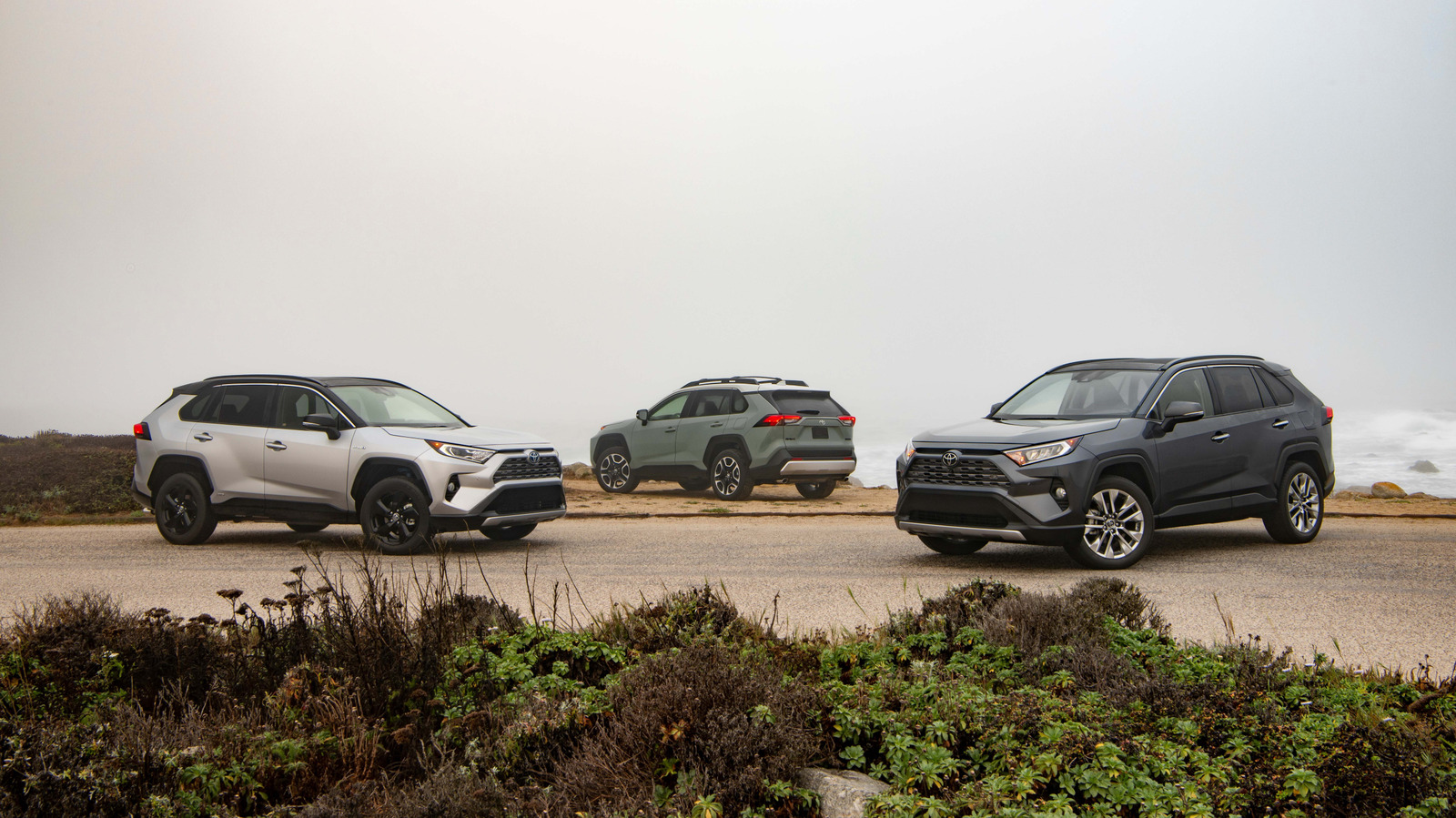
Since the very beginning, Toyota’s RAV4 has been a no-nonsense vehicle. Well, kind of. The original RAV4 concept, pre-production models, and first full generation had an undeniable spunkiness thanks to their “toy car” looks and a cheeky soft-top version, which is still the best RAV4 ever made. But as soon as sales data came rolling in, showing that the practical four-door variant was selling well, the RAV4 would grow up and continue on as Toyota’s champion of sober family reliability — separated from any silly distractions.
As you may know, this pivot in the RAV4’s image would handsomely pay off. As one of the pioneers of the crossover segment, the compact Toyota exploded in popularity and has, over the last 30 years, become shorthand for what a modern, reliable car looks like to automotive consumers. You can’t go anywhere without seeing one; trust us, we once counted 436 RAV4s on a road trip. But remember what Hannah Montana sang that one time? “Nobody’s perfect.” As lauded as the RAV4 is for its triumphs of transportation, it is still made up of plastic and metal parts that will fail now and then.
Today, we ask one further question: what are the least reliable RAV4s? It’s a harsh proposition, considering the model’s overall legendary dependability, but for those in the market for used crossovers, these are the truly important conversations. Whether it’s electrical problems, powertrain issues, or something else entirely, the following model years are the ones that didn’t quite live up to the badge.
2001 Toyota RAV4: Faulty ECM, transmission issues
The second-generation RAV4, which debuted for the 2001 model year, went in a more sophisticated direction compared to early examples. But this was still the early 2000s, meaning fun stuff like a five-speed manual transmission was still on the menu. The new RAV4 was also slightly larger and packed a 148-horsepower 2.0-liter inline-four that could be driven through a front-wheel or all-wheel-drive system. Reviews were positive at launch, and journalists were pleased with how nearly every aspect of the Toyota had been improved from the first iteration.
However, after miles had been put on the new RAV4s by their owners, a few issues began to arise. Chief among them was the engine control module (ECM), which also runs the automatic transmission and was causing unexpected warning lights and rough shifts. The very first complaints were filed with the National Highway Traffic Safety Administration (NHTSA) in 2001 and 2002, citing slight hesitations in acceleration, odd shifting points, and the transmission popping out of gear at low speeds.
By 2006, the transmission problems had grown to a scale that prompted Toyota to issue an official bulletin on the matter, disclosing that the ECM and its manufacturing process were at fault for the problem. Additionally, Toyota’s bulletin recommended replacing the ECM on affected vehicles to prevent further gearbox issues. Importantly, there was never a recall for this issue, despite the fact that it affected several model years, as you’ll soon find out.
2002 Toyota RAV4: Worse transmission failures
For the 2002 model year, the initial reactions from reviewers were once again quite positive. The RAV4 still sat on the well-received updated platform and was praised for its urban utility prowess and expanding number of options, especially with the more expensive “L” package. However, as often happens, the ECM issues weren’t immediately widespread enough for Toyota to completely ditch the transmission and its accompanying electronics before new model years were introduced. The result was that 2002 models inherited all the same issues that had plagued the RAV4 in 2001.
If anything, from a 2026 perspective, the issues only seemed to multiply for the 2002 RAV4. According to the NHTSA’s database, the 2002 RAV4 has received 555 total complaints — over 200 more than the prior year. Of the 555, 384 complaints label the powertrain as the main issue, and of those, more than 300 identify the transmission specifically as the cause. The 2002 model year distinguishes itself from the previous year in that the transmission issues began to manifest in a slightly more intense fashion.
These early reports cite problems such as a loud transmission thump comparable to being rear-ended when attempting to accelerate from a stop, as well as the transmission failing to shift at all. Many more reports cite unwanted acceleration and surging at low RPM, while others describe random intermittent cuts in power. And as one could imagine, several owners were quoted for transmission repairs and rebuilds instead of a simple ECM replacement (possibly before the 2006 bulletin was released), costing folks thousands of dollars in parts and labor. There were also several instances of physical damage to the transmission due to the faulty ECM, causing more issues for those who never received the ECM replacement.
2006 Toyota RAV4: Steering and suspension failures
In 2006, the same year it began to deal with the transmission issues on the second-gen cars, Toyota also launched the brand-new third-gen RAV4. Gone was any five-speed manual, and in came a sleek new body, updated tech, and an optional 269-horsepower V6. This was easily the best RAV4 yet, and when equipped with the top engine and all-wheel drive, this thing was the quickest in its class by 2 seconds, and outhandled all of them, too. If you need a cherry on top, we’ll point you to the 9-inch movie display for the rear passengers — a big deal for 2006.
This debut model year for the third-gen, however, had a major Achilles’ heel hiding in its steering column. In 2008, Toyota released a bulletin regarding many customers’ reports of hearing clunking and popping from the steering system, an issue that was found to be caused by a failing steering intermediate shaft. Other complaints even mention some loss of steering control or locked steering wheels in 2006 models. This intermediate shaft issue was the most pervasive of all for the 2006 model year, according to the reported complaints in the NHTSA database.
There was never a recall for the steering issue; however, there was a notable recall (one of 11 recalls in total, by the way) for the rear suspension arm. After a 2012 NHTSA investigation, it was found that improper alignment practices could lead to the threaded portion of the rear suspension corroding and eventually failing or separating. The recall came that August and was reissued in 2013 and 2016, but NHTSA complaints regarding underside rust and rear suspension failures continue into the present day. Shockingly, this isn’t even the worst situation from this third-gen RAV4.
2007 Toyota RAV4: Oil consumption
You may have noticed that we haven’t yet mentioned the third-gen RAV4’s standard engine. That’s because its relevance sits mostly with the 2007 model year and one major issue. The 166-horsepower 2.4-liter 2AZ-FE engine was used in several Toyota models over the years and is known to last with proper care. But in the RAV4’s case, oil consumption clouded what was otherwise a perfect package.
The 2007 RAV4 has the most NHTSA complaints of any model featured in this article, at an impressive 1,003 complaints. Among them, 236 cited issues with the engine or oil consumption. Years after release, when the problem began to emerge, Toyota issued another service bulletin to its dealers, teaching its technicians how to test for oil consumption and disclosing that it had redesigned the piston assembly to fix the issue (yikes). It even got to the point where Toyota had to launch a warranty extension program for qualifying vehicles (i.e., those that were tested by Toyota dealers and confirmed to have the issue).
One could make a case for the 2007 RAV4 as the worst model year ever. In addition to the oil consumption problem that took years to fix, the rear suspension and steering shaft issues from the 2006 model were still occurring. There was even a recall for malfunctioning accessory seat-heater wiring that could cause interior fires (and two additional investigations into power-window switches that caught on fire, which also ended in a recall), on top of the hundreds of complaints in other categories. With more than 1,000 complaints, 14 recalls, and four investigations, this RAV4 may be the one to avoid.
2013 Toyota RAV4: Torque converter, battery defects
Fast-forward to the next decade, and Toyota is releasing the all-new fourth-generation RAV4, with many changes in store. The exterior design took the model into the modern age, with a clunky and somewhat unfamiliar look compared with previous RAV4s. Additionally, Toyota eliminated the third-row seating and removed the door-mounted spare tire in favor of a floor-mounted unit. The saddest news, however, was that the powerful V6 would live no further in the RAV4, and the model would instead use just one 176-horsepower 2.5-liter engine across all trims.
Still, none of those changes are the reason for its appearance on this list. Instead, the 2013 RAV4 suffered from defects in both the torque converter and battery areas. Several early NHTSA complaints from 2013 report power surges, drivetrain jerking, stuttering, and even transmission failure in low-mileage examples. As the pool of complaints grew, Toyota eventually released a service bulletin addressing the issue, citing the transmission’s torque converter as being at fault. According to the bulletin, these torque converter stuttering instances occurred in the 25 to 50 mph range and at light loads. Toyota later extended warranty coverage for the shudder on 2013 to 2015 models.
Thirty-two torque converter complaints were sent to the NHTSA out of the 256 total complaints, but the number one issue was the battery hold-down. Toyota disclosed that some replacement batteries have smaller tops than others and, under sharp turns, they could let the positive terminal touch the metal hold-down bracket. There was a recall for this problem in 2023, but the 2013 RAV4 still had other miscellaneous annoyances, like faulty accessory trailer-light modules.
2014 Toyota RAV4: Power steering loss
Unsurprisingly, the 2014 RAV4 had to deal with the carryover of the 2013 model’s issues, and there are a significant number of NHTSA complaints for both the battery hold-down and transmission/torque converter issues listed for this model year. But the 2014 model year saw an equal number of complaints for power steering problems and “powertrain” issues.
Around 2015, the NHTSA began to receive concerning reports of RAV4 steering systems experiencing changes in steering effort and causing minor electrical issues. Later on, additional reports were submitted with more intense accounts, featuring steering wheels that locked up at low speed and multiple dashboard lights flashing before the vehicle lost power steering. And while the overall number of NHTSA complaints for the 2014 RAV4 is relatively low at 198, the power steering issue was something Toyota couldn’t ignore. In 2015, a recall citing “an unexpected loss of power steering [that] increases the risk of a crash” was issued. The recall details that a component of the ECU that controls the electric power steering may have been damaged during manufacturing, leading to these unexpected failures.
But even if a 2014 RAV4 has had the recall service done, potential buyers aren’t necessarily off the hook quite yet. For one, there was an infotainment screen issue that affected multiple 2012 to 2014 models of the Highlander, Prius, Avalon, 4Runner, Corolla, Tundra, Tacoma, Camry, and RAV4. Toyota released a service bulletin explaining that debris could easily get stuck between the screen and the faceplate, rendering any inputs useless. Plus, there was another recall, in addition to the power steering, trailer lights, and battery issues, that involved improperly installed accessory running boards and roof racks that could fall off while driving.
2019 Toyota RAV4: Fuel pump failures
The fifth-gen Toyota RAV4 debuted for the 2019 model year and attempted to continue the hybrid-forward mantra that had been established with the first hybrid RAV4 back in 2016. Its body style was boxier and more approachable than those of its predecessors, and a 203-horsepower 2.5-liter inline-four was the standard engine, lined up next to the 219-horsepower optional hybrid powertrain, both of which would be outclassed when the 302-horsepower RAV4 Prime came slightly later. It would be misleading to say that the 2019 Toyota RAV4 wasn’t desirable and well-reviewed, as it would go on to become the best-selling non-truck in 2019 (as it was in 2017 and 2018). In short, the 2019 RAV4 got a lot of things right.
The 2019 model logged 888 NHTSA complaints, a number fairly close to that extra-problematic 2007 model’s total. A significant 256 of those 888 (or about 28%) stemmed from fuel-system issues. The NHTSA reports for these issues began in the summer of 2019, with owners experiencing random fuel cutoff while driving, abnormal auto-shutoff behavior when filling up, and lack of power (or none at all) when accelerating. The fuel pump failures were part of an issue that affected at least 32 different models across Toyota’s and Lexus’s lineups, and ended up with a recall that was expanded to cover the RAV4 in November 2020.
The RAV4 has even more qualifications for its spot on this list, though, as there were also more than 200 NHTSA complaints relating to the engine, many of them citing failing coolant valves that ended up leaking. Additionally, a recall for an unresponsive backup camera was issued for this model, stating that certain RAV4 backup cameras failed to turn on when in reverse, increasing the risk of an accident.
2020 Toyota RAV4: Porous engine blocks
In 2020, the RAV4 was once again a force to be reckoned with in the industry. For the fourth year in a row, it was the best-selling non-truck in the U.S., and in 2020 specifically, it beat the next best-selling non-truck by nearly 100,000 units. That next-best, by the way, was its direct competitor, the Honda CR-V — not an easy rival to beat. Again, the “least reliable” RAV4s are still some of the most dependable cars out there, but the 2020 model is unquestionably notable for its defects.
The big headline was engine block issues in 2020 model-year iterations of the Lexus ES 300h, Toyota Camry, Toyota Avalon Hybrid, and Toyota RAV4 (including some hybrid variants). Manufacturing errors caused some engine blocks to be too porous, which could lead to cracking and subsequent leaks of coolant. In an NHTSA document regarding the eventual recall that was issued, it was stated that this defect could cause engine overheating, stalling, mechanical failure, and an increased risk of fire. These claims match the complaints in the NHTSA database, where 181 of the 642 total complaints cited the engine as the main issue (the largest single category for the 2020 model year).
The 2020 Toyota RAV4 also experienced several other issues, including “engine maintenance required” codes and dashboard warnings for hybrid system failures, the latter of which were sometimes evidence of corroded rear electric motor cables — an issue that affected at least 800,000 vehicles across Toyota’s lineup from model years 2019 through 2023. It’s also worth mentioning that the 2020 RAV4 had two airbag-related recalls; however, it still has a five-star overall safety rating from the NHTSA.
