
Close Menu
H24 NewsH24 News

    Subscribe to Updates

    Get the latest creative news from FooBar about art, design and business.

    What's Hot

    No Car’s Lines Were Ruined More Thoroughly Than When The Avanti Was Made Into A Sedan

    November 15, 2026

    Prince Harry in Ukraine meeting Invictus 2027 hopefuls | Russia-Ukraine war News

    November 15, 2026

    The Camera Sensor Cleaning Mistake You Don’t Want To Make

    November 15, 2026
    Facebook X (Twitter) Instagram
    Trending
    • No Car’s Lines Were Ruined More Thoroughly Than When The Avanti Was Made Into A Sedan
    • Prince Harry in Ukraine meeting Invictus 2027 hopefuls | Russia-Ukraine war News
    • The Camera Sensor Cleaning Mistake You Don’t Want To Make
    • Metallica, Jack Black, St. Vincent Honor Iron Maiden at 2026 Rock Hall
    • 7 Fuel Sipping Classic Cars For Thrifty Driving Enthusiasts
    • Morocco becomes first Arab nation in FIFA’s top five men’s rankings | Football
    • ‘Blade Runner’ Owner Alcon Wants to Give IP a Major Video Game
    • See Billy Evans’ First TV Interview Since ‘You Can See Everything’
    H24 NewsH24 News
    Subscribe
    • Home
    • Top News
    • Technology
    • Entertainment
    • Lifestyle
    • Home & Living
    • Auto
    H24 NewsH24 News
    Home»Technology»James Webb telescope finds ice older than the star it orbits
    Technology

    James Webb telescope finds ice older than the star it orbits

    h24By h24November 14, 2026No Comments2 Mins Read
    Facebook Twitter Pinterest LinkedIn Tumblr Email
    James Webb telescope finds ice older than the star it orbits
    Share
    Facebook Twitter LinkedIn Pinterest Email

    James Webb telescope finds ice older than the star it orbits

    The structure of the water ice also pointed in this direction. When water freezes at moderate temperatures, its molecules settle into an orderly crystal lattice, and crystalline ice produces a sharp peak in the spectrum just above 3 micrometers. That peak was absent at Beta Pictoris. The ice is almost entirely amorphous, a disordered, glass-like solid that forms when water molecules freeze so fast and so cold that they stick wherever they land. The team estimates that less than 7 percent of the water ice in the system is crystalline, which is somewhat surprising.

    Models predicted that ice in debris disks should mostly be crystalline. For amorphous ice to stay in that form, it has to remain colder than about 100 Kelvin, or minus 173° Celsius. Otherwise, something has to keep breaking up its crystal structure, such as high-energy ultraviolet light, cosmic rays, or particles streaming from the star. Either way, the researchers concluded the ice most likely formed in the interstellar medium, long before the planets of Beta Pictoris began to take shape.

    The remaining question was how the icy grains got spread so evenly across the disk.

    Constant collisions

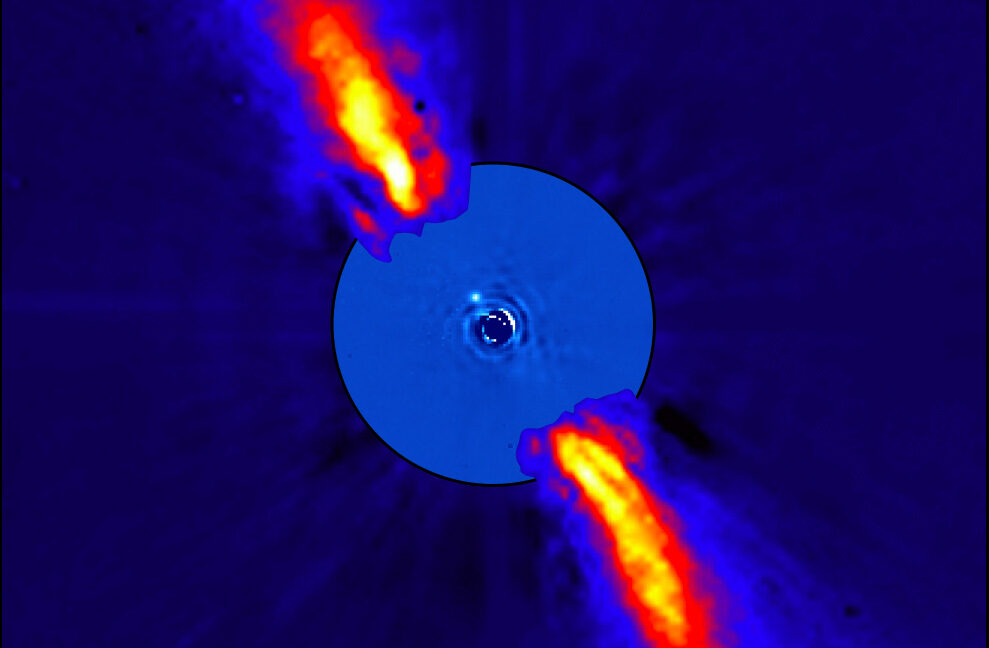
    The team argues that this even ice distribution requires frequent collisions among planetesimals. Each collision would release fresh icy dust, including ice that had been buried and protected deep inside the colliding bodies, replenishing what the starlight destroys. We already have evidence that such collisions do happen. Earlier infrared images revealed a curved, lopsided streak of dust in the southwestern arm of the disk, thought to be debris from a violent collision a little less than halfway out from the star.

    Betti’s team’s findings support the idea that the disk’s carbon monoxide gas comes from colliding icy bodies and offer an explanation of how ice can survive in an environment constantly exposed to ultraviolet light. What the team could not do is determine exactly how much crystalline ice is present or rule out other molecules hiding in the mixture.

    But if a young planetary system 64 light-years away may have started with much the same icy ingredients as ours, then primordial, interstellar ice might be a common ingredient of planetary systems in general. This means the raw materials for water-rich, potentially habitable worlds might be common, too.

    Science, 2026. DOI: 10.1126/science.adw7770

    Finds ICE James older orbits Star telescope Webb
    Share. Facebook Twitter Pinterest LinkedIn Tumblr Email
    h24
    • Website

    Related Posts

    The Camera Sensor Cleaning Mistake You Don’t Want To Make

    November 15, 2026

    ‘Blade Runner’ Owner Alcon Wants to Give IP a Major Video Game

    November 15, 2026

    Gaming PC GPUs Vs. Console GPUs: What’s The Difference Between Them?

    November 15, 2026

    Comments are closed.

    Demo
    Top Posts

    U2’s ‘Carnaval de Luz’ Album: Review

    November 8, 20263 Views

    Victorian Architecture Meets Mediterranean Charm in This Warm and Whimsical London Home

    November 7, 20263 Views

    Jensen Huang Admits Affair with Suspected Chinese Spy

    November 9, 20262 Views
    Stay In Touch
    • Facebook
    • YouTube
    • TikTok
    • WhatsApp
    • Twitter
    • Instagram
    Latest Reviews

    Subscribe to Updates

    Get the latest tech news from FooBar about tech, design and biz.

    Demo
    Most Popular

    U2’s ‘Carnaval de Luz’ Album: Review

    November 8, 20263 Views

    Victorian Architecture Meets Mediterranean Charm in This Warm and Whimsical London Home

    November 7, 20263 Views

    Jensen Huang Admits Affair with Suspected Chinese Spy

    November 9, 20262 Views
    Our Picks

    No Car’s Lines Were Ruined More Thoroughly Than When The Avanti Was Made Into A Sedan

    November 15, 2026

    Prince Harry in Ukraine meeting Invictus 2027 hopefuls | Russia-Ukraine war News

    November 15, 2026

    The Camera Sensor Cleaning Mistake You Don’t Want To Make

    November 15, 2026

    Subscribe to Updates

    Get the latest creative news from FooBar about art, design and business.

    • About Us
    • Terms and Conditions
    • Privacy Policy
    • Disclaimer
    © 2026 H24. Designed by Webpointt.

    Type above and press Enter to search. Press Esc to cancel.