

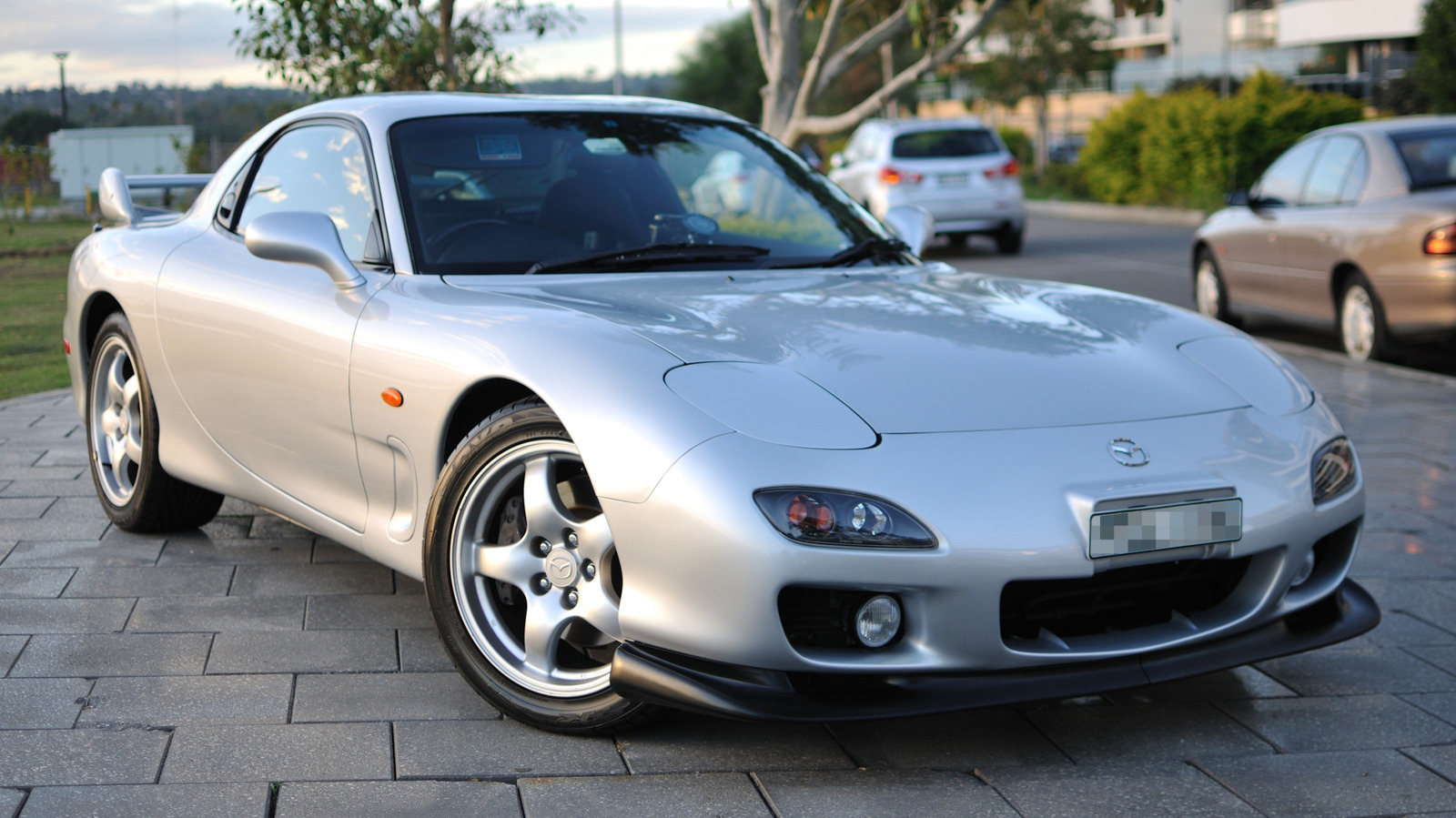
Beyond the realms of car enthusiasm, most normies wouldn’t have actually heard of a rotary engine – also known as a Wankel engine (after Felix Wankel, the man who patented the design in the first place). These are fondly called “spinning Doritos” because at their heart is a triangular rotor that whizzes around a central shaft and makes power in a similar way to how a regular piston engine does. There are many pros and cons to rotary engines, and the cons are why they have seldom been used in automobiles.
When it comes to street cars, the most coveted example is Mazda’s famous RX-7. The same brand was also responsible for arguably the most mythical race car ever created: the quad-rotor 787B. It won the 1991 edition of the famed 24 Hours of Le Mans and leaves a lasting impression on anyone who hears it, thanks to the orgasmic, high-pitched wail it generates as it climbs toward 9,000 rpm.
But Mazda isn’t the only car brand to have ever used a rotary engine in its production cars. The very first instance came from a German company called NSU (which eventually became part of Audi), and there were also examples from Citroën and the Russian brand Lada. Maxton, a low-volume sports car maker from the U.S., also briefly used rotary engines in the Rollerskate. But since it used Mazda engines and was built in such small numbers, it is often discounted.
Mazda has (by some margin) the greatest number of rotary-powered production cars
In fact, the famed Japanese brand is estimated to have built around two million rotaries between 1967 and 2012, starting with the much-loved Cosmo sports car and ending with the equally adored RX-8 coupe. It has since resurrected the rotary, but only as a generator that forms part of a hybrid package in the MX-30 electric SUV, so it hardly counts.
Mazda really did try it all at the height of its rotary days, even building the now highly collectible Rotary Pickup. It was — and is — humanity’s sole rotary-powered pickup truck, equipped with a 110-horsepower 1.3-liter Wankel unit, and made purely for the U.S. and Canadian markets. The company built around 15,000 examples, and well-maintained, low-mileage trucks still go for close to $30,000. Further afield, ardent enthusiasts will also remember the Mazda Furai concept, which is among the weirdest one-off cars ever built.
NSU was the first to put rotaries into production
Before Mazda’s love affair with Wankels, NSU rolled out the very first rotary-powered production car, the Spider, at the 1963 Frankfurt Auto Show. Its single-rotor, 500cc engine wasn’t hugely powerful: it produced just 50 hp when it debuted, and maxed out at 54 hp in its most powerful guise. Despite getting positive reviews from the automotive press, the Spider never really took off. Just 2,400 units are estimated to have been built before production ended in 1967.
NSU replaced it with the Ro 80, which was a sleek, four-door sedan with a 115-hp twin-rotor motor and a fancy independent suspension. It was so good that European Car of the Year jurors voted it as their winning candidate for 1968 – making it the first German vehicle to ever win the coveted prize. It enjoyed a 10-year run rolling off the production lines, with NSU building around 37,000 examples before retiring it in 1977.
Citroën also gave rotary engines a shot
It was in 1964 that Citroën struck up a partnership with NSU to develop rotary engines. While NSU went on to join the VW Group, Citroën stayed the course and eventually unveiled the M35 in the late ’60s — its first true rotary-powered car, built in a limited run of 267 examples. Based on an Ami 8 – the same model James May used during the “Top Gear” classic time trial rally challenge in Mallorca – the M35 even had Citroën’s super-soft hydropneumatic suspension, with 49 rampant French horses under the hood.
Then came the GS Birotor in 1973, whose twin-rotor setup produced an even mightier 106 hp and allowed for a top speed of 109 mph. Citroën eventually dropped its rotary experiment by the late ’70s, in part due to low sales volumes, but also because of the world’s oil crisis. The latter is significant here because rotary engines, by nature, guzzle fuel. They burn a lot of oil, too.
Lada is actually the second-longest adopter of rotaries
Yes, who’d have thought it? Little about these cars ever made it past the Iron Curtain, but Lada started its Wankel journey in 1978 with the VAZ-21018. Though it may have shared model codes with a fax machine of some kind, the 21018 did have a pretty prominent place in society. The four-door sedan used a 71-hp rotary engine that was basically reverse-engineered from either an NSU or a Mazda engine, depending on who you ask, and proved horribly unreliable. Some accounts say these engines couldn’t manage more than 12,000 miles before succumbing to issues such as seal and bearing failures.
Lada took another crack at it in 1982 and created a twin-rotor engine with two outputs: 115 and 140 hp. These were fitted to the VAZ-21019 sedan, and provided a notable step up in performance from “regular” Ladas. They proved slightly more reliable too, at the cost of poorer fuel economy. Lada did stick by its rotary engines all the way until the early 2000s, albeit on an increasingly small scale, before wrapping up production entirely.
Some other manufacturers got really close to putting rotary cars into production
Citroën, Mazda, Lada, and NSU aren’t the only manufacturers to have dabbled with rotary cars. General Motors was at the height of its power in the ’70s, and saw an opportunity to reinvent how vehicles were engineered by placing rotaries at the heart of its plans. It had intended to offer its then-new Vega compact car with a Wankel engine, and committed $50 million just to license the technology. There was even the Aerovette: the best-looking Corvette of all time that never made it out of the concept stage and had a rotary engine. Unfortunately, as would soon happen with Citroën and the GS Birotor, the global oil crisis forced GM to ditch its rotary plans by the end of 1974.
Mercedes-Benz also got in on the act with its jaw-dropping C 111 experimental vehicle, first previewed at the 1969 Frankfurt Auto Show. It seemingly had everything a discerning celebrity would’ve wanted back then: a funky wedge-shaped body, a striking orange metallic paint job, and gullwing doors. Whereas the very first experiment had a three-rotor configuration, the second cranked it up to four rotors and was claimed to have a top speed of 186 mph. It all sounds super exciting, right? Well, Mercedes chose not to put it into production. Sorry to burst your several-second dream of owning one. But of the rotary-powered cars that did make production, which would you most like to own?
