

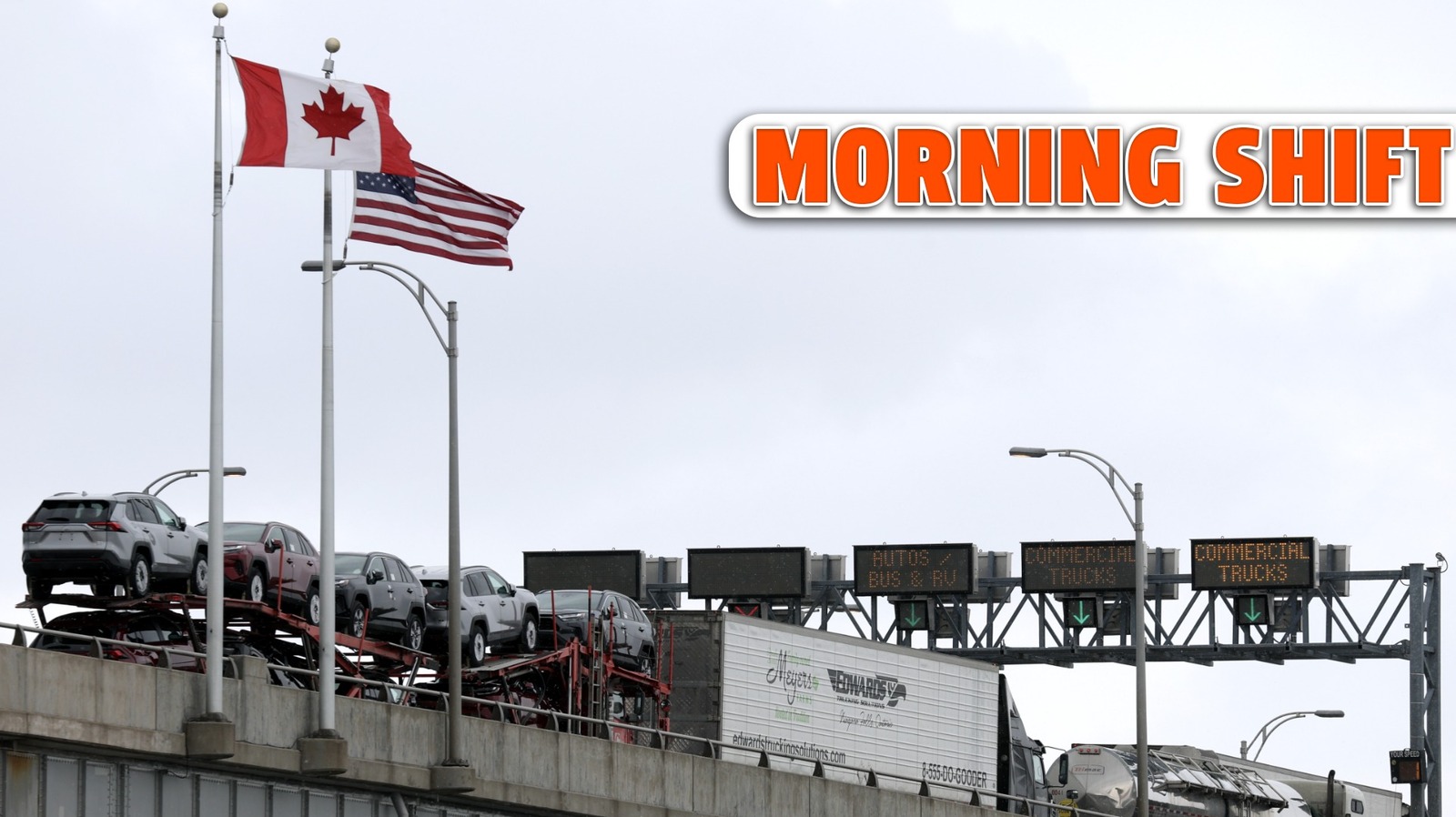
With everything else going on in the world at the moment, you’d be forgiven for forgetting that there’s an entire trade war happening between the U.S. and Canada right now, but I’m here to remind you that bad boy is still raging. Much of that is thanks to auto tariffs — one of the major sticking points dividing the two North American countries as negotiations heat back up following a last-minute collapse this summer.
Automotive and other key industrial sectors, like steel, are holding up a deal that could end the two-year trade war. President Trump enacted a 25% tariff on auto imports in April of 2025, and Canada came right back with its own in-kind duties soon after. It’s a real mess, and it’s driving up costs for everyone. Obviously, this didn’t need to happen. Trump didn’t need to do this, but here we are. From Automotive News:
Both sets of tariffs include exemptions for locally made parts, which lowers the effective tariff rate on Canadian vehicles exported to the United States to about 12.5 per cent and U.S. exports to Canada to about 21.25 per cent — though the exact rate varies by plant and model.
[…]
Trump has repeatedly claimed the United States does not need Canadian-made cars and pressed automakers to shift production south of the border. Canadian Prime Minister Mark Carney has maintained that any agreement with the United States must leave Canada with a viable auto sector.
Ottawa has been pushing for a deal that will put the effective tariff rate for Canadian vehicle exports to the United States on an even keel with those built south of the border but has been hard-pressed to get there, [Automotive Parts Manufacturers’ Association president, Flavio] Volpe said.
As negotiators closed in on a deal this summer by pitching a broader parts exemption, the U.S. offer would have left Canadian autos facing up an effective tariff of up to 7.5 per cent tariffs, he said. While an improvement over the roughly 12.5 per cent rate automakers face today, it is still higher than the industry’s profit margin, making it too high for Ottawa to accept, Volpe added.
Canadian negotiators are “not religious” about what mechanism is used to bring the effective tariff rate down, Volpe said, but want to put plants on both sides of the border back on an even playing field.
Counterintuitively, U.S. assembly plants are not immune to tariffs.
Parts compliant with the United States-Mexico-Canada Agreement reach U.S. assembly lines tariff-free, but American-made vehicles compliant with the trade deal can include 25 per cent parts content from overseas. That content faces up to 25-per-cent tariffs, translating into a tariff rate on U.S.-made vehicles of as much as 6.5 per cent.
A 3.75-per-cent MSRP credit for American-made vehicles offered by the U.S. Department of Commerce — effective through 2030 — offsets part of these added costs.
But even automakers building USMCA-compliant vehicles in the United States can face an effective tariff rate of 2.75 per cent. The tally can be more or less, depending on where companies source their parts.
The five automakers that currently produce vehicles in Canada — the Big Three, Honda and Toyota — are pushing hard for an interim deal that would close or eliminate the tariff gap between Canadian and U.S. plants, even if it’s a short-term solution.
Right now, there’s no real timetable for when a deal could be reached, though Canadian pundits are actually aware that Trump has threatened to hike tariffs to 50% at the start of 2027. While they don’t think it’ll happen, with Trump, it can never be truly ruled out.
