

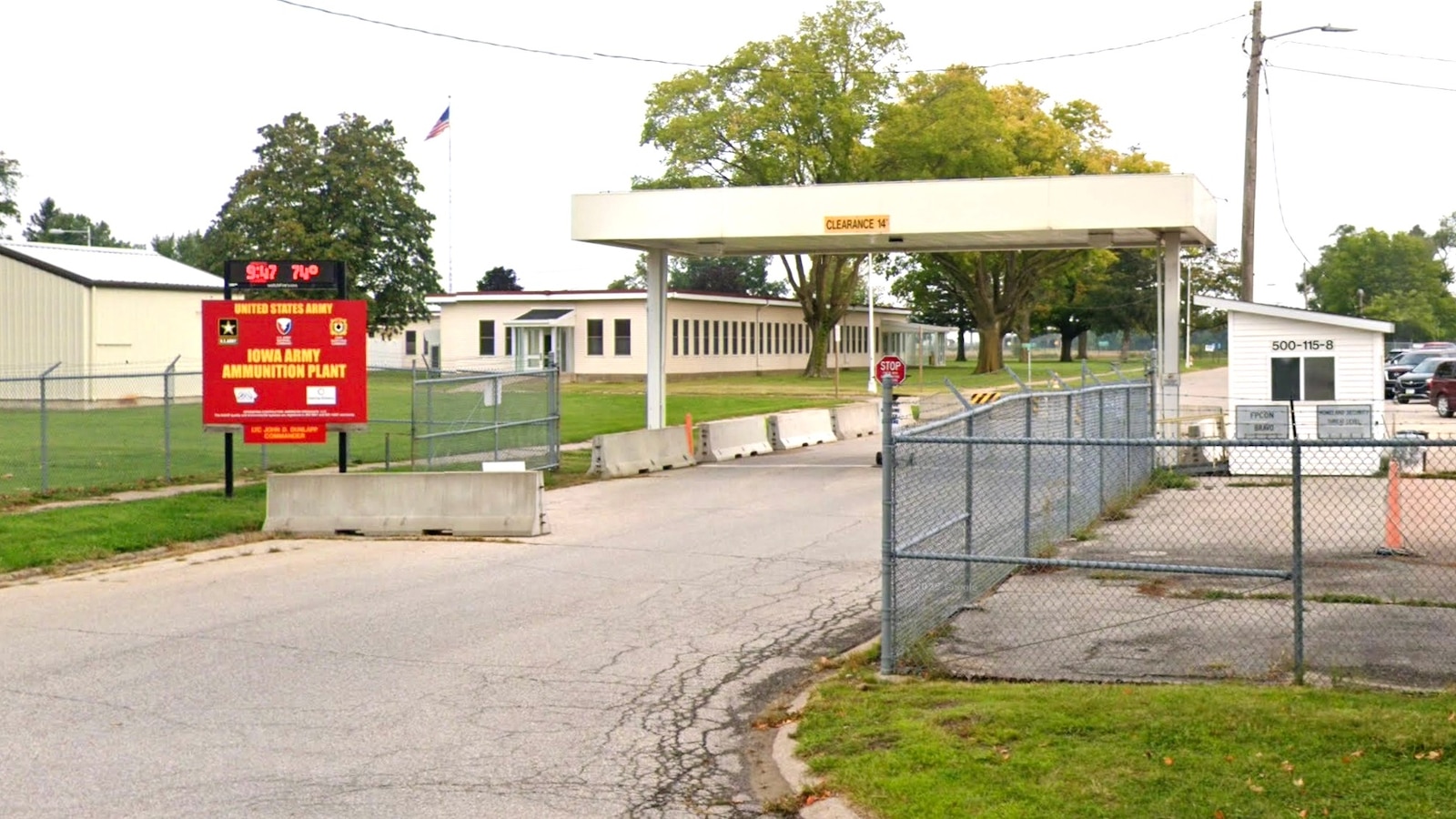
The controlled detonation of nearly 10,000 pounds of lead azine at a U.S. Army plant in Iowa has been postponed until early next week, Army officials announced Thursday, a day before the planned blast.
“Public safety is the Army’s top priority, and I have directed Army Materiel Command to postpone tomorrow’s controlled detonation at the Iowa Army Ammunition Plant in Middletown, Iowa until Monday, November 23,” Army Secretary Adam Telle said in a post on social media.
Two rapid, controlled detonations were scheduled to take place at the Middletown plant midday Friday to safely dispose of degraded lead azide, according to the U.S. Army.
Telle said Monday is the “latest possible moment prior to a forecasted temperature drop, which would risk further destabilization of the material.”
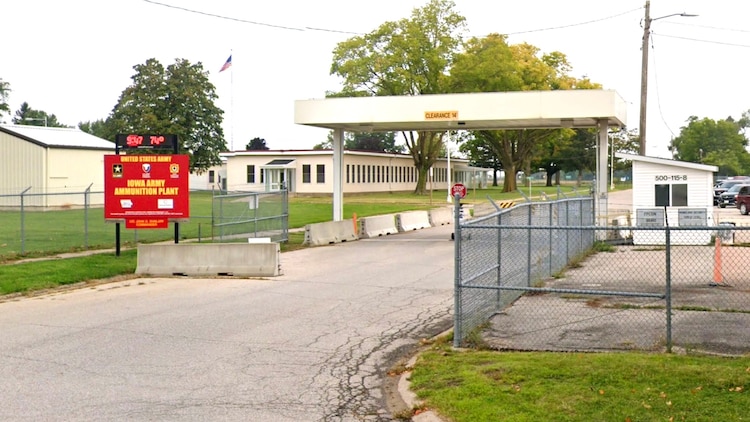
The Iowa Army Ammunition Plant is shown in Des Moines County, Iowa.
Google Maps Street View
His announcement comes hours after two environmental groups asked a federal court to halt the plan — alleging that the U.S. Environmental Protection Agency approved a permit for the detonations without adequately considering the potential health and environmental consequences or fully evaluating alternatives — as some officials also expressed concerns about the Army’s plan, how it was communicated to the public and risk of potential lead exposure.
“Public communication is essential to public trust. Therefore, the Army will continue to actively engage with state and local officials throughout the region to distribute accurate, up-to-date information,” Telle said Thursday.
Republican Iowa Sen. Chuck Grassley said on social media that he raised concerns and questions about the controlled detonation with the Army and “emphasized the need for increased communication,” and that the delay is “to further educate the public.”
Here’s what to know about the operation.
How the barrels will be detonated
Sixty-eight barrels — approximately 9,700 pounds — of the explosive material are set to be detonated, according to Army Sustainment Command spokesperson Justine Barati.
The detonation was initially scheduled to occur at approximately noon CT Friday, the Army said in a public advisory on Wednesday. A time for Monday’s detonation has not yet been announced.
The barrels will be detonated “inside earth-covered magazines made of concrete: and surrounded by two-story-high sand barriers, the advisory said.
“Before and during the detonation, the soil above the earth-covered magazines will be thoroughly saturated with water, and water misters will be spraying,” the advisory said. “These measures should reduce the amount of lead that migrates from the detonation through the air off the installation.”
Expected blast impacts as residents asked to evacuate
The blast is expected to result in loud noises and ground vibrations, as well as a dust plume “that will contain some lead” and is expected to linger for up to one hour, depending on wind speed, the Army said.
The Army will be updating plume maps up until and after the detonation, Barati said. Ahead of the operation, the Army released maps on potential airborne exposure to toxic lead dust via the air and on surfaces, which it said are being updated before and after the detonation.

The U.S. Army released this public advisory on the potential lead air dispersion on Nov. 17, 2026, ahead of a planned detonation of degraded lead azide in Middletown, Iowa.
U.S. Army
“The U.S. Army has taken extraordinary measures to mitigate the plume by following strict permit requirements set by the EPA such as earthworks, soil wetting, and air sampling,” the Army said in a public advisory earlier this week.
The blast could also break windows. Due to that risk, the Army said it had asked residents near Middletown City Park and Butterfly Park to temporarily evacuate the area for several hours before and after the scheduled detonation “out of an abundance of caution.” Updated guidance in light of the postponement has not yet been released.

The U.S. Army released this public advisory on the potential lead surface deposition on Nov. 17, 2026, ahead of a planned detonation of degraded lead azide in Middletown, Iowa.
U.S. Army
Middletown, which is located near the Iowa-Illinois border in southeastern Iowa, has a population of nearly 400 people, according to U.S. Census data.
Residents who need a place to stay were invited to the Armed Forces Reserve Center. Those who couldn’t evacuate were advised to stay indoors and keep all windows and doors closed during the possible exposure period.
People were also being advised to clean play surfaces for children and windowsills once the U.S. Army determines the air exposure period has ended.
In addition to air monitoring during the blast, sampling will occur afterward to “identify material that may need to be cleaned up,” the Army said.
“A large ‘safe zone’ area has been identified and extends well beyond the area that the blast can reach,” the Army said. “Fire and emergency responders will be staged and on standby to respond to an emergency if needed.”
Multiple school districts planned to close
Lead exposure is a particular concern for young children. According to the U.S. Centers for Disease Control and Prevention, there is no safe blood lead level for children. Even low blood lead levels “are associated with developmental delays, difficulty learning, and behavioral issues,” the CDC said. Many children with lead in their blood will not show symptoms immediately after an exposure. Parents concerned about lead exposure should speak with their child’s primary care provider about lead level testing.
Due to the controlled detonation, multiple school districts in the area planned to close their doors on Friday out of an abundance of caution. They included the Burlington Community School District, which serves Middletown, as well as Mediapolis, Columbus, Danville and Winfield Mt. Union. The schools have yet to issue updated plans in the wake of the detonation’s postponement.
Destroying in place ‘only responsible option’

The Iowa Army Ammunition Plant sign is shown in Middletown, Iowa.
Lori McFate/U.S. Army
The controlled detonation is to dispose of the degraded lead azide, which is highly sensitive and extremely unstable, the Army said. Due to the risks of accidental detonation in packing and transporting it, “safely destroying it in place is the only responsible option,” the Army said.
Lead azide is the primary explosive used to initiate munitions.
According to the EPA, which permitted the detonation, the “recrystallization of the stored lead azide has increased the material’s sensitivity to friction and shock, and disturbing the containers of lead azide could create an unacceptable risk of unintentional detonation.”
The Iowa Army Ammunition Plant makes medium- and large-caliber munitions for the Department of Defense.
Emergency motion seeks to stop detonation
The day before the planned detonation, the Iowa Environmental Council and Sierra Club filed an emergency motion, seeking a stay of the EPA-issued permit authorizing the detonation.
The filing argues that the detonation could spread lead dust across a large area, potentially reaching communities more than 100 miles from the plant. The Army’s latest modeling projects that lead dust could settle across an area approximately 25 miles long and 5 miles wide, including homes and waterways, according to the filing. The groups further argue that people, livestock and wildlife could also continue to face exposures to lead once it settles into the ground.
The filing also questions the Army and EPA’s handling of public notification, alleging that some of the potentially impacted communities were not given direct or timely notice.
The groups asked the federal appeals court to rule by 10 a.m. CT Friday, right before the detonation was initially scheduled to occur.
Prior to the detonation’s postponement, Iowa Sen.-elect Josh Turek and Gov.-elect Rob Sand, both Democrats, also criticized the communication from the Army while calling for Friday’s detonation to be paused.
“An unacceptable lack of communication and clarity has made Iowans understandably concerned and angry about this situation,” Sand said in a statement on Thursday. “The public deserves to know, if this is the safest option, why other options were worse. If it isn’t as safe as possible to do this tomorrow, it shouldn’t happen tomorrow.”
ABC News has reached out to the Army and EPA for comment on the emergency motion and has not yet received a response.
