

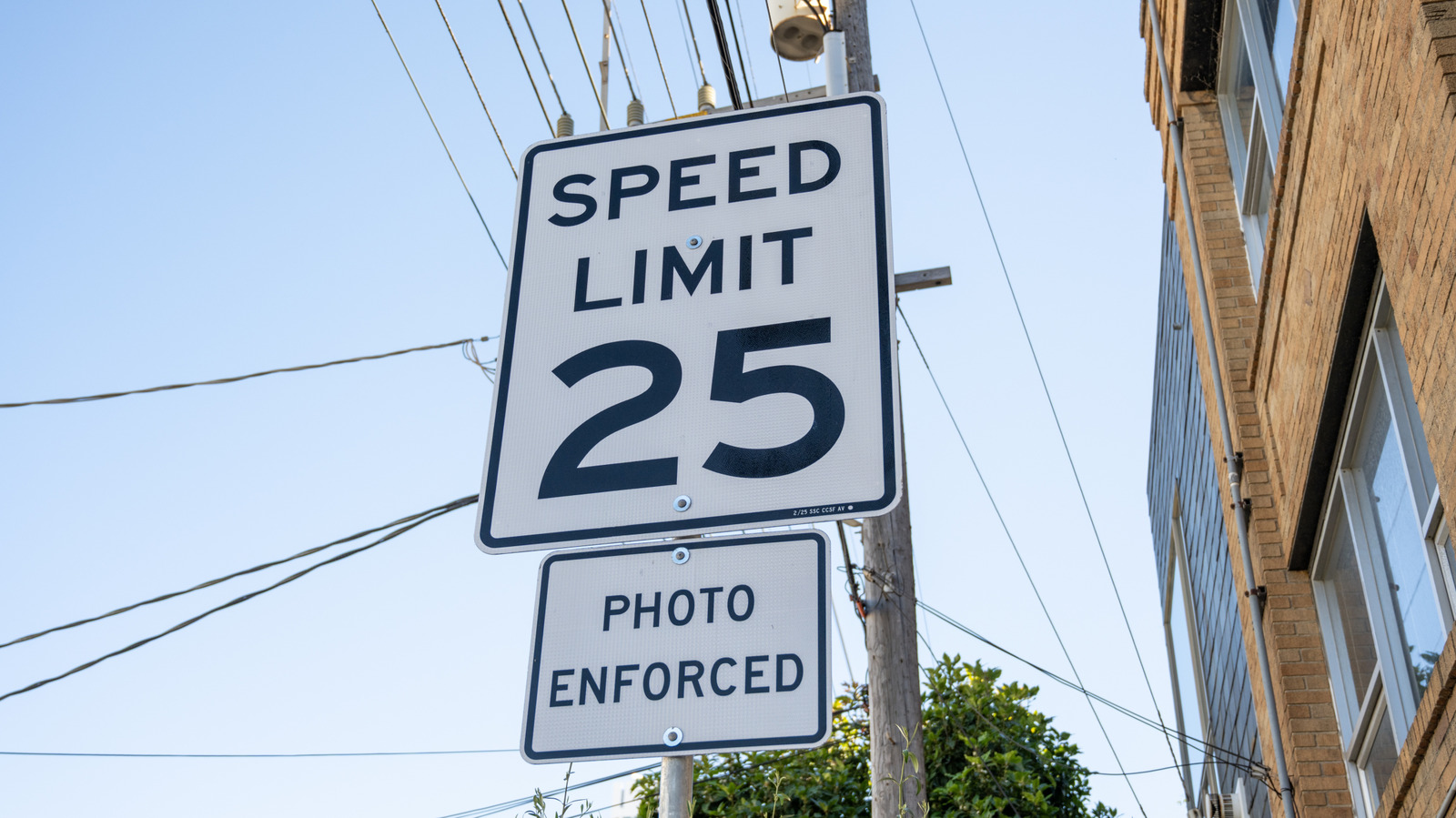
You’re on the road, approaching a speed limit sign. Beside it, a cop sits clocking the speeds of passersby. Your next move will determine whether you end up going about your day or on the side of the road with a cop taking down your information. So, no pressure, but do you slow down before or after that speed limit sign? The answer varies depending on whether you’re approaching a speed limit higher or lower than the current posted limit. Regardless, your answer could cost you a speeding ticket, which could be even more costly in certain states.
The rules surrounding speed limit signs are standard across the country, but how they’re followed can vary. The rules, however, are fairly clear. The federal government doesn’t set speed limits, even on interstates. Instead, states and local municipalities depend on traffic engineers to help decide posted speed limits. Those are determined by considering laws, the areas where the speed limit will be posted, and the safety of the area, including the flow of traffic and frequency of accidents. (Not, though, the long-touted “85th-percentile rule.”)
Traffic engineers often refer to their bible, the 1,100-page-plus Manual on Uniform Traffic Control Devices, written and revised by the Federal Highway Administration. If you’re curious, turn to Page 84 of the revised 11th edition, where the section “Speed Limit Signs and Plaques” resides. The item to pay attention to is number 14: “Speed Limit (R2-1) signs, indicating speed limits for which posting is required by law, shall be located at points of change from one speed limit to another.”
The limit starts at the sign
To bluntly translate this government literature: The speed limit starts at the sign. That means drivers should be slowing down while approaching a slower speed zone, arriving at the correct speed when crossing next to it. If the speed limit sign is higher, the driver should not accelerate until reaching the posted sign. Those of you who see that 55 mph sign on a highway that eventually turns into a 70 mph expressway know better, but you still speed up knowing in less than a quarter-mile, your speed will be fine. Legally, though, it’s not … not just yet.
State officers agree. The Colorado State Patrol, after polling the same question on Facebook, referred followers to the Manual on Uniform Traffic Control devices as well. California Highway Patrol Officer Dan Olivas informed a reader inquiring on this same question in Anaheim’s Daily Bulletin that the state Department of Transportation’s literature “refers to placing speed limit signs at the start of the designated speed zone, which alludes to the speed limit zone starting where the sign is placed.”
Simply put, drivers should be slowing down to the posted speed before reaching a slower speed limit sign, and only accelerate after passing a faster speed limit sign. Anything else will likely result in a pricey ticket if you’re caught.
