

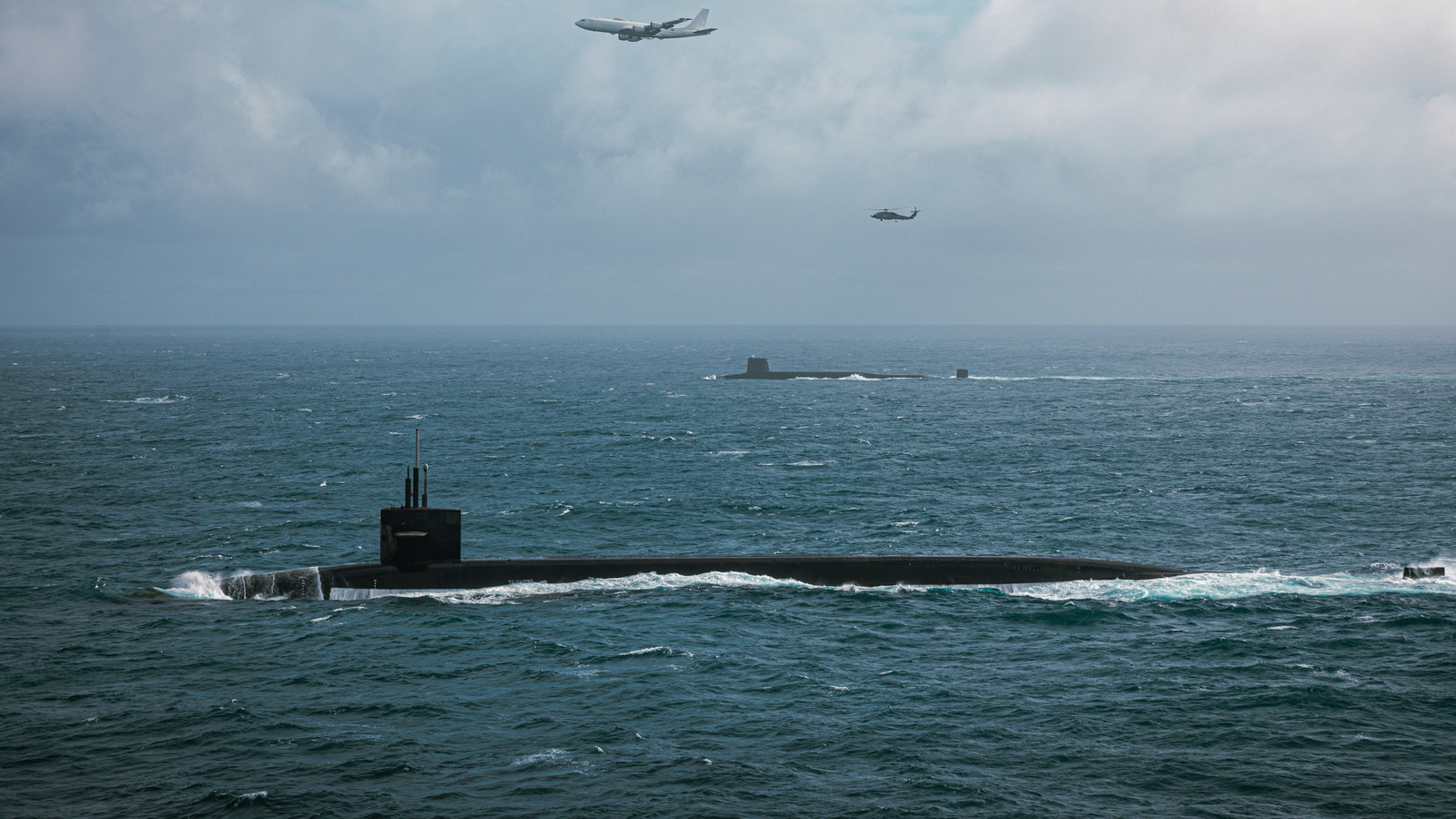
At first, submarines employed propulsion systems that relied on fuels like compressed air, steam, and even human labor. Now, roughly 400 years after the first working submarine prototype was tested, modern ones are much more sophisticated, and have even inspired atomic-age concept cars. They’ve come a long way from their roots, although the basic principle has always remained the same: Sneak up on your target and execute the mission.
The U.S. Navy boasts the world’s most high-tech submarine force in the world, largely because it employs an entirely nuclear fleet consisting of 65 active subs. The Navy is planning to build more, too, with another 14 nuclear subs in the works as part of a $77-billion contract signed this year. There are two companies currently involved in building nuclear subs for the U.S. Navy — General Dynamics’ Electric Boat division (EB) based in Groton, Connecticut, and Huntington Ingalls Industries’ Newport News Shipbuilding division (HII) based in Newport News, Virginia. Both EB and HII work for the Navy under contract, and both are involved in different aspects of each submarine constructed.
However, while EB and HII are based in Groton and Newport News respectively, both have other locations where other portions of the actual sub-building process takes place. For example, EB does engineering in New London, Connecticut and hull fabrication and outfitting at Quonset Point, Rhode Island on a retired naval base where the Quonset hut originated. HII houses most of its production at its Newport News location, but also has a location in Goose Creek, South Carolina primarily responsible for metal fabrication.
For the EB and HII, nuclear-powered submarines are nothing new
Nuclear subs have been around since the early 1950s, as the first to grace the world’s oceans was the USS Nautilus, commissioned on September 30, 1954 and built by EB. Alongside the USS Nautilus, EB has pioneered a huge swath of submarine innovations, such as building the Navy’s first welded-hull submarine and the first strategic-deterrent sub. EB has been involved in designing 15 nuclear sub classes since the USS Nautilus was first penned, and is currently responsible for the Virginia-class sub — a replacement for the Ohio-class vessel. EB is currently working on the Virginia payload module as well, which gives existing Virginia-class subs more firepower, as well as cargo capacity.
HII’s prowess in the submarine field is no less impressive: The company has built over 60 of them. Today, it’s involved in the construction of the Virginia-class submarines alongside EB, of which it’s helped deliver a total of 26. It’s also working with EB on the upcoming Columbia-class nuclear sub, tentatively set to hit the seas sometime in 2028.
While EB and HII are the only two companies building nuclear subs for the Navy today, this wasn’t always the case. Historically, five other shipbuilders have done so alongside the current two. These included Navy-owned shipyards in Kittery, Maine, and in Mare Island, California. Privately owned yards also took part, including the Fore River Shipbuilding Co. in Quincy, Massachusetts, the New York Shipbuilding Corp. in Camden, New Jersey, and the Ingalls Shipbuilding Corp. in Pascagoula, Mississippi — now part of HII.
Why a nuclear submarine is an important naval asset
The introduction of the nuclear submarine in 1954 was a major step forward in the world of naval warfare. For example, World War II-era diesel-electric submarines typically had to surface every few days. However, the USS Nautilus could stay submerged much longer, 14 days or more. Range was greatly increased, too, as the Nautilus managed to travel over 60,000 nautical miles by early 1957 on a single reactor core. Its third and final core lasted even longer, providing 150,000 nautical miles of naval patrol before entering retirement. For context, the WWII-era diesel-electric sub USS Balao could only travel about 11,000 nautical miles before needing to return for fuel.
The benefits extended outside the scope of range, too. Beginning in 1960 with the deployment of the USS George Washington nuclear sub, U.S. nuclear submarines gained the ability to launch intercontinental ballistic missiles while submerged. Speed is also on a nuclear sub’s side, as many regularly cruise at roughly 20 knots while submerged, while modern diesel-electric subs only manage about 8 knots while cruising on battery power.
The nuclear submarine gave the United States Navy a large advantage across the seas over seven decades ago, and while seven companies once worked to build them, only EB and HII remain active in the endeavor. The Navy’s current 65-strong fleet also enjoys some serious job security, as certain members of the fast-incoming Columbia-Class are expected to serve roughly into the 2080s.
