
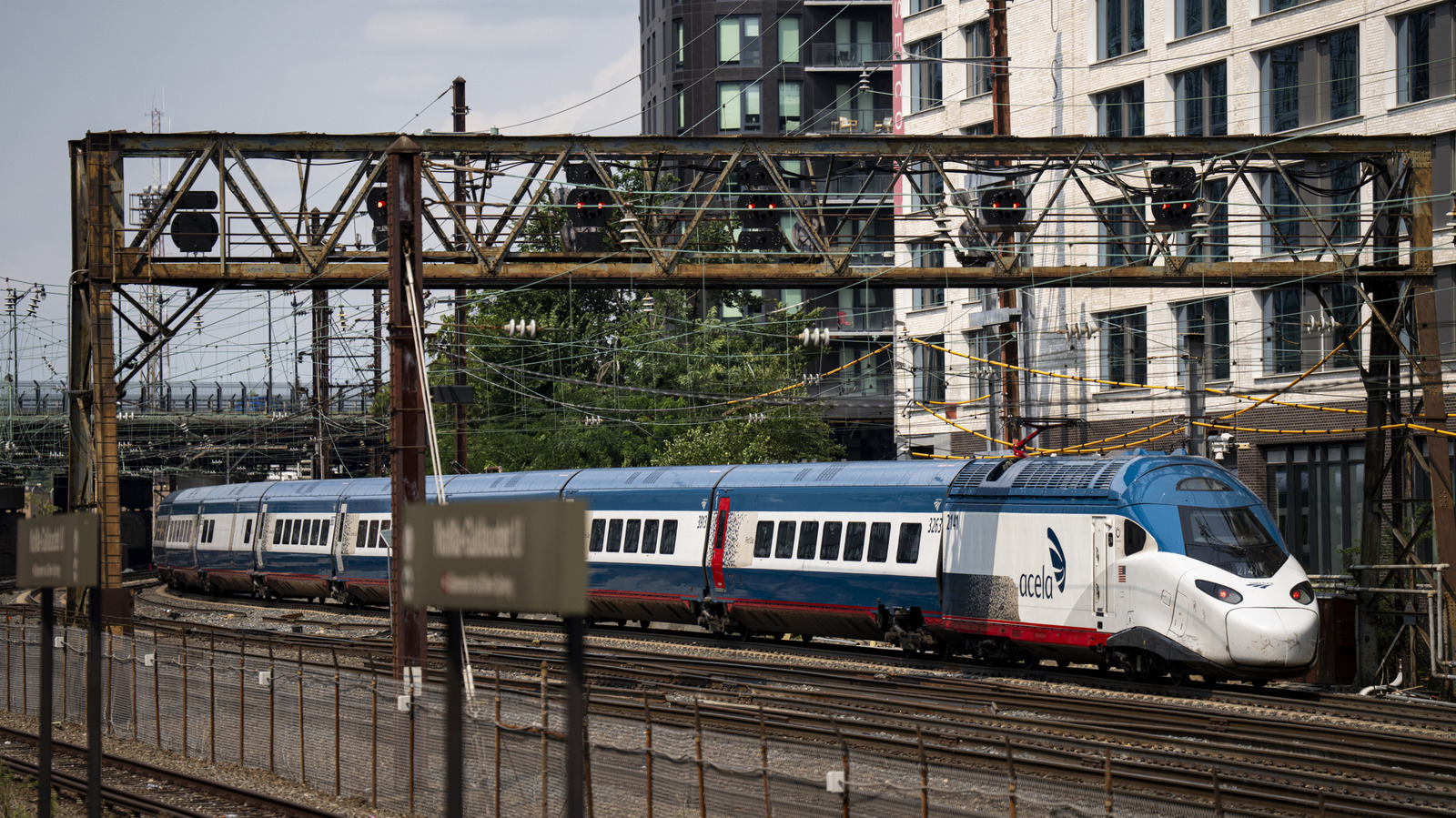
The uninformed often fall for the illusion that high-speed rail is simply a railroad operating extremely fast trains. In actuality, it’s an entire transportation system tightly regulated by government agencies. The Federal Railroad Administration (FRA) attempted to spur high-speed rail development in 2018 by letting operators run high-speed trains on existing speed-limited infrastructure, but so far, no new service has usurped Amtrak’s Acela on the Northeast Corridor as America’s fastest train. Businesses simply won’t buy passenger trains capable of hitting 220 miles per hour if they don’t have the dedicated right-of-way needed to reach top speed.
The FRA defines three tiers of Passenger Equipment Safety Standards delineated by top speed. Each increasing tier requires more stringent crashworthiness, maintenance, and safety standards. Most passenger trains in the United States fall under Tier I, which is limited to 125 mph. Tier II, or higher-speed rail, has a legal top speed of 160 mph. Tier III, established in 2018, allows for speeds up to 220 mph. However, the trains are only half of the equation.
The agency stipulates that high-speed trains can’t travel faster than 160 mph on any track with at-grade crossings. Even tracks with a 160 mph limit are rare in the U.S., as the Northeast Corridor has only four short stretches where Acela trains are allowed to touch 160 mph. The rest of the route between Boston and Washington, D.C. is limited to 125 mph. With as many as 386 passengers on board, there can’t be any risk of anyone or anything entering the tracks and causing a catastrophic crash.
High-speed rail was always envisioned with dedicated tracks
Japan’s Shinkansen is viewed as the archetypal form of high-speed rail. The moniker translates into English as “new main line.” Japanese National Railways opened the first Shinkansen line between Tokyo and Osaka in 1964. The five-year construction effort created a new dedicated high-speed main line, separate from commuter and freight traffic on the parallel Tōkaidō Main Line. France’s TGV and other high-speed networks in Europe borrowed this dedicated-infrastructure philosophy from the Shinkansen.
Florida’s Brightline is the most prominent U.S. example of the failings of shared rights-of-way. The higher-speed service between Miami and Orlando is heavily constrained by its 325-mile route, specifically the portion shared with the Florida East Coast Railway. According to Brightline, its trains are limited to 79 mph along this section. The 67-mile stretch between Miami and West Palm Beach, owned by the freight service, has 156 at-grade crossings. The abundance of crossings creates opportunities for trains to hit vehicles and pedestrians. Brightline-involved collisions have killed over 200 people since 2017. Dedicated rights-of-way are not only faster, they are far safer.
