

Equipping a sports car with a big and powerful engine is all well and good. But if the car in question is designed like a cinder block, then it’s just wasting the engine’s potential. As a car speeds up, the air resistance around it increases. And a car with a sleeker design can slip through the air with less resistance, thus granting it better performance. That, in a very basic nutshell, is why aerodynamics matter.
Now, drag coefficient (Cd) isn’t the be-all and end-all when it comes to measuring a car’s aerodynamics as a whole. Something like drag area, which combines that metric with frontal area measurements, provides a more complete picture. Nevertheless, drag coefficient scores still provide a solid impression as to just how slippery a car is — and such figures are more readily available from automakers, too.
Sleek designs certainly aren’t reserved exclusively for performance models; economy cars like Honda’s little hybrid that could, the Insight, can also be marvelously slippery. But this article will be focusing on some of the sleekest sports and performance cars out from across the last century, covering old-school favorites such as the Tatra T87 with modern marvels like Volkswagen’s XL1.
Tatra T87
This Czechoslavkian masterpiece is a genuinely fascinating piece of design. Before moving onto the aerodynamic aspects of the T87, it’s first worth covering what else makes it such an intriguing automobile. Motivation is sourced from a rear-engined 2.9-liter V8, which kicked out an impressive-for-the-era 85 horsepower. Back in the ’40s, that was a serious amount of power to be dealing with, and Tatra ensured its effectiveness by complimenting it with a seriously slippery design.
German Zeppelins provided plenty of influence behind the T87’s iconic shape, and the end result was a drag coefficient of just 0.36 Cd. This enabled the 85-horse V8 to propel the T87 to an impressive 100 mph, although the handling characteristics of a rear-engined machine with independent swing-axle suspension resulted in a fair number of accidents. Rumor has it that, due to so many Nazi officers meeting their maker in T87 accidents, the car was actually banned for use – but the accuracy of these claims has been contested over the years. Still, it all adds to the fascinating history of Tatra’s aerodynamic masterpiece.
Production spanned from 1936 to 1950, albeit with a gap during the war years. Despite such a wide production window, though, just over 3,000 T87s were ever built. It proved to be a significant influence to Ferdinand Porsche, and today, it’s a cherished classic that attracts collectors willing to pay over $100,000.
Pagani Huayra
The Huayra replaced the awesome Zonda in 2011, and it boasted a design that was just as striking. It was a million-dollar masterpiece at launch, packing a 720-horsepower twin-turbocharged 6.0-liter V12, capable of propelling it along to a top speed of 224 mph. Aerodynamic trickery helps the Italian to remain stable at speed, with front- and rear-mounted flaps that rise and fall to alter downforce levels.
It’s important to remember that a supercar like this needs to be comfortable performing through the corners as well as the straight lines. Here’s where that active aero really proves its relevancy. Those four flaps allow the Huayra to transform itself depending on the given requirements. While flat, the Huayra boasts a drag coefficient of just 0.31 Cd (as proven by a Mercedes wind tunnel). But they can also flip up to assist the car with braking and keep it planted through the corners.
Much like Pagani did with the Zonda, as the Huayra began to age, the automaker began to produce numerous special editions. Among them was a rolling $7.3 million air piece dubbed the Codalunga. The svelte model sports various ducts and diffusers, plus a longtail design – which is a known method of reducing the amount of drag a car’s body produces. However, the Codalunga has not been individually tested in a wind tunnel, so whether it beats the standard Huayra’s 0.31 Cd isn’t officially known.
McLaren Speedtail
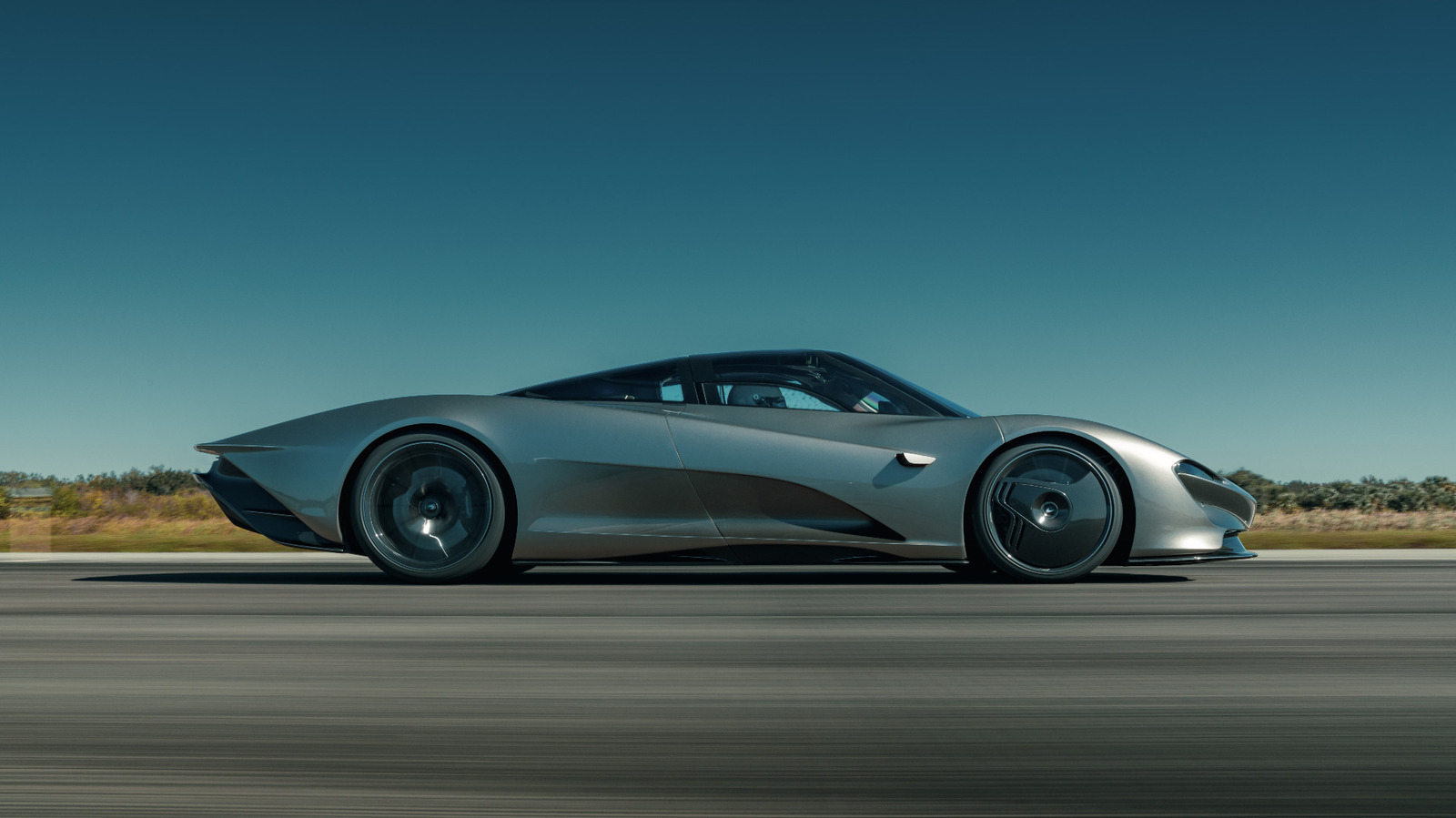
While on the topic of longtail designs, it seems appropriate to mention the McLaren Speedtail. This car categorically proves the effectiveness of such a design, with a drag coefficient of just under 0.29 Cd. The British firm from Woking knows a thing or two about churning out slippery supercars, but this Speedtail is something of a caricature; it sits 3 feet longer than the F1, and it’s even longer than the F1 GTR Longtail. Helping it cut through the air as precisely as possible is a narrow frontal area, numerous concealed ducts, a complete lack of rear-view mirrors, and front wheels that are almost entirely enclosed.
Of course, a sleek design still needs to be complimented with a mighty power train if impressive performance is the end goal. And with a turbocharged 4.0-liter V8 that combines its efforts with a single electric motor to produce 1,035 horsepower, the Speedtail recipe is certainly a comprehensive one. Combined with a dry weight of just 3,153 pounds, that’s enough to see the Speedtail achieve a top speed of 250 mph. Plus, it’ll crack 186 mph in just shy of half the time required by its forefather, the mighty F1.
Chevrolet Corvette C6
As impressive as the McLaren Speedtail’s design is, what’s arguably far more impressive is that a $44,245 Corvette from 2005 can match the $2.25 million British hypercar’s drag coefficient. With a drag coefficient of just 0.28 Cd, the C6 Chevy is surprisingly slippery. This wasn’t a one-hit-wonder for Chevrolet, either, as previous generations had also proven to be remarkably aerodynamic as well. But the C6 manages to outdo them all (albeit only marginally). The C4 boasted a drag coefficient of 0.34 Cd, while the C5 sat at 0.29 Cd. It’s worth noting that later generations – including the current C8 — also sit behind the C6’s rating.
It’s no wonder that people think the C6 is still the best Corvette to date. Regardless of whether you agree or not, it’s hard to find real fault with the C6. It combined a brilliantly efficient design with supercar-rivaling performance; the most powerful iteration was the 638-horsepower ZR1, which could top 200 mph. Even the base models were serious performers thanks to an LS1 lurking beneath that low-slung hood. These cars were affordable when new, and they’re still great bang-for-buck choices today, with entry-level coupes and convertibles both available for sub-$25,000 – proving that slippery sports cars don’t exclusively belong in six-figure price brackets.
BMW i8
Electric cars and hybrids pay a lot of attention to aerodynamics, as being able to slip through the air with minimal resistance is a particularly effective way of increasing a vehicle’s range. That’s led to buyers of electrified vehicles becoming understandably obsessed with realistic and effective ranges. It should come as no surprise, then, that BMW’s bold hybridized i8 sports a drag coefficient of just 0.26 Cd.
That drag coefficient proves that the i8’s striking design isn’t all about stealing the attention of passers by, in fact, it’s really quite clever. The various slices and slashes between those layered body panels help to direct airflow into the car’s various radiators, which allows the i8 to disregard active aero. Even the cockpit itself is teardrop-shaped to reduce drag, while the flared rear pillars help keep the visuals sweet without damaging any aerodynamic benefits.
With a turbocharged 1.5-liter inline-three engine and single electric motor tackling the task of motivation, the i8’s power train recipe could not be more different from that of the aforementioned Corvette. However, just like the C6, the BMW i8 now finds itself at a very tempting price point, with early examples now changing hands for sub-$40,000.
Nissan GT-R
This one’s probably something of a surprise, as unlike so many of the other mentions on this list, the Nissan GT-R doesn’t exactly look immensely slippery. It’s not particularly low-slung, it doesn’t incorporate an obvious longtail design, nothing else about it is clearly geared toward aerodynamics — plus, there’s a great big spoiler adorning the trunk. However, that hasn’t stopped the GT-R from being a technological marvel with a drag coefficient of only 0.26 Cd. Yep, this chunky model with heaps of boost and gaping grills matches the rating of BMW’s slippery little eco-minded coupe.
The secrets of the GT-R low drag coefficient are actually somewhat hidden. It sports an almost completely flat floor, a functional diffuser which helps to channel airflow efficiency, and a slightly tapered rear overhang. Also helping to direct the air in an effective manner are what Nissan describes as “aero-blades” adorning the front fenders, while the narrow fender vents help to provide valuable downforce at the front, too.
Throughout its impressive 18-year tenure, the R35 GT-R saw the power from its twin-turbocharged 3.8-liter V6 rise to genuine supercar levels. And the clever aero tweaks it received over those years helped drivers to make the most of that strength. It came incredibly close to cracking the 7-minute barrier on the Nurburgring, peaking with a time of 7:08.679 in its 2013 Nismo guise — breaking the world record for fastest volume production car in the process.
Volkswagen XL1
All of the cars featured upon this list are aerodynamically impressive, and they certainly sit a long way removed from the least aerodynamic cars ever made. However, the Volkswagen XL1 stands in a class of its own. The sole purpose of this striking little hybridized-diesel inline-three-powered sports car was to be as mightily efficient as possible.
The headline number here is a drag coefficient of just 0.19 Cd. To get this number down so far, it combines many of the other engineering techniques used by other cars on this list. It very obviously sports a teardrop profile like the i8, allowing the smoothest possible path for airflow. Like the GT-R, the car’s floor is completely flat, preventing the underside from pushing against the wind. And — going above and beyond the Speedtail in this regard – covered rear wheels assist the XL1 in achieving its remarkably low drag coefficient.
It wasn’t just aerodynamic efficiency that Volkswagen was chasing with the XL1. It was also designed to be immensely frugal on fuel, to the point where a Honda Insight or Toyota Prius might look like a big-block Chevy from the ’70s in comparison. On the European combined test cycle, Volkswagen managed to achieve a frankly mind-boggling 313 mpg, a feat helped by the model’s incredibly low curb weight (courtesy of magnesium wheels and a carbon-fiber monocoque chassis).
