

Some engines make a lot of horsepower but are as fleeting as a sunset on a warm summer night. The BMW S65 V8 found in the E90-generation M3 that needs rod bearings as preventative maintenance comes to mind, as do Subaru’s EJ engines, which are 4-cylinders with a terrible reputation for reliability. But in making some of the best performance engines of all time, some manufacturers have over-built their engines so they are good time for a long time.
For this list, we picked engines that can take a ton of abuse worry free. Some engines, like Toyota’s 2JZ-GTE, aren’t the most powerful out of the box. But they are under-stressed from the factory, and tuners have more than doubled the engine’s output without affecting reliability. Other engines, like the Viper V10, are powerful, reliable, and have an even higher performance ceiling. With that being said, this is not a comprehensive list of brick-house engines by any means. If we missed a motor with a beefcake block, let us know down in the comments.
Toyota 2JZ-GTE
Jesse shouldn’t have been surprised by the engine under the hood of the mangled Supra Paul Walker’s character procured in the first “The Fast and the Furious.” All fourth-generation Supras came with 2JZ engines. Nonetheless, his excitement was justified. The 2JZ, particularly the factory twin-turbocharged 2JZ-GTE variant, is well known for making big power without sacrificing reliability.
For the U.S. market, the 2JZ-GTE was only found under the hood of the MKIV Supra Turbo, and a little under 7,000 Supra Turbos were sold Stateside. The twin-turbo straight-6 made 320 horsepower from the factory. But it wasn’t long before tuners found that the engine was capable of so much more.
The 2JZ’s secret sauce largely comes from how its bottom end is constructed. The 2JZ is a closed-deck engine, meaning that the top of the cylinder walls are supported by metal. This, along with the cast iron construction of the 2JZ’s engine block, makes the cylinders really strong and able to hold up to a lot of turbo boost. Also, the 2JZ has a forged steel crankshaft. The difference between cast and forged crankshafts comes down to strength and cost. The more common cast crankshaft is cheaper to make, but they are less likely to survive the stresses of an engine outputting big horsepower long term. All of this over-engineering means that the 2JZ-GTE can make upward of 700 horsepower without touching the bottom end.
Nissan VR38DETT
When Nissan revived the GT-R nameplate for the 2009 model year, it was a revelation. The all-wheel-drive coupe put down acceleration, braking, and road-holding numbers that bested supercars like the Porsche 911 Turbo and Lamborghini LP640 for a fraction of the cost. The center piece of its performance was the twin-turbo 3.8-liter V6 designated VR38DETT. The new power plant was rated at 480 horsepower and 430 pound-feet of torque. The 0-to-60 times that the GT-R achieved made the automotive press suspect that Nissan low-balled the twin-turbo V6’s output. Indeed, when MotorTrend Channel dyno tested a 2009 GT-R, the outlet found that the factory torque figure was underrated by 40 pound-feet.
Nissan took great care in building the VR38DETT. Each all-aluminum engine was hand assembled by expert craftsmen at Nissan’s Yokohama plant in Japan. The VR38 is over square , which means that the engine’s construction is more suited for high revs. The GT-R’s engine has plasma-coated cylinder bores, which reduce friction and improve cooling. Like the 2JZ-GTE, the VR38 has a robust closed-deck engine block.
Also like the 2JZ, tuners found that the VR38DETT could make a lot more horsepower without a ton of extra work. The engine can safely make around 600 horsepower with the factory turbochargers. Anything above that and you’ll be swapping turbos and replacing the connecting rods, which are a known weak point above 650 foot-pounds of torque. The good news is that once the rods are taken care of, the factory block can withstand more than 1,000 hp.
Porsche Mezger
When Porsche debuted its race-car-for-the-road GT3 in 1999, it equipped its most hardcore 911 with a race-proven engine. The GT3 ditched the standard 911’s then-new water-cooled flat-6 engine for a power plant based on the Le Mans-winning 911 GT1, which, in turn, was derived from the engine found in the dominant 962 Group C racer. The engine initially displaced 3.6-liters and output 360 horsepower.
Since it shares the same M96 designation as the engine in the back of the standard 911, enthusiasts call the race-derived engine “Mezger,” after Porsche’s engine guru Hans Mezger. He was behind the design of the 962 engine, as well as the power plants in the original 911, the 917 race car, and McLaren’s 1983-to-1987 F1 entries. In 2000, Porsche strapped a pair of turbochargers to the Mezger for the 911 Turbo, which was good for 415 hp. Porsche used the Mezger in the GT2, GT3, and Turbo until 2013. The ultimate factory Mezger was the turbocharged GT2 RS that made 612 hp. If that’s not enough, tuners regularly extract 1,000-plus horsepower out of the Mezger.
Over the years, the engine has gained a reputation for its reliability. The reasons why the Mezger flat-6 is bulletproof come down to its construction. First off, the Mezger has a gear-driven intermediate shaft (IMS) with a plain bearing that is always lubricated by engine oil. The unit won’t fail catastrophically like the problematic, sealed IMS bearings that plague the M96 and M97 engines found in lesser, contemporary 911s. The Mezger also has a more rigid, reinforced crankcase compared to the standard sixes. And it has individual, pressed-in cylinder liners that are easier to replace than the bores in the standard engine.
The Chevrolet LS-series V8
What can be said that hasn’t already been said about Chevrolet’s venerable LS V8? It’s powerful, compact, and has an abundant aftermarket. The inciting incident for the LS was the 375-horsepower Lotus-designed LT5 V8 in the ZR-1. The good ol’ boys on Chevy’s internal small-block V8 team were miffed , so they decided to do something that wouldn’t have Chevy going to an outside contractor for the ‘Vette ever again. The team designed an all-aluminum pushrod V8 , dubbed the LS1, from the ground up. When the LS1 was introduced in the 1997 Corvette, it was only down 30 horsepower compared to the more exotic, quad-cam LT5.
GM adapted the LS architecture for numerous applications over its 18-year run. As such, LS-architecture V8s were available in a bunch of different flavors, from iron-block 4.8-liter truck motors to all-aluminum 7.0-liter Corvette mills. The most powerful factory variant, the LS9, made 638 hp with help from a 2.3-liter Roots-type supercharger. But crate engines from Chevrolet Performance like the LSX-454R can make over 700 hp without boost.
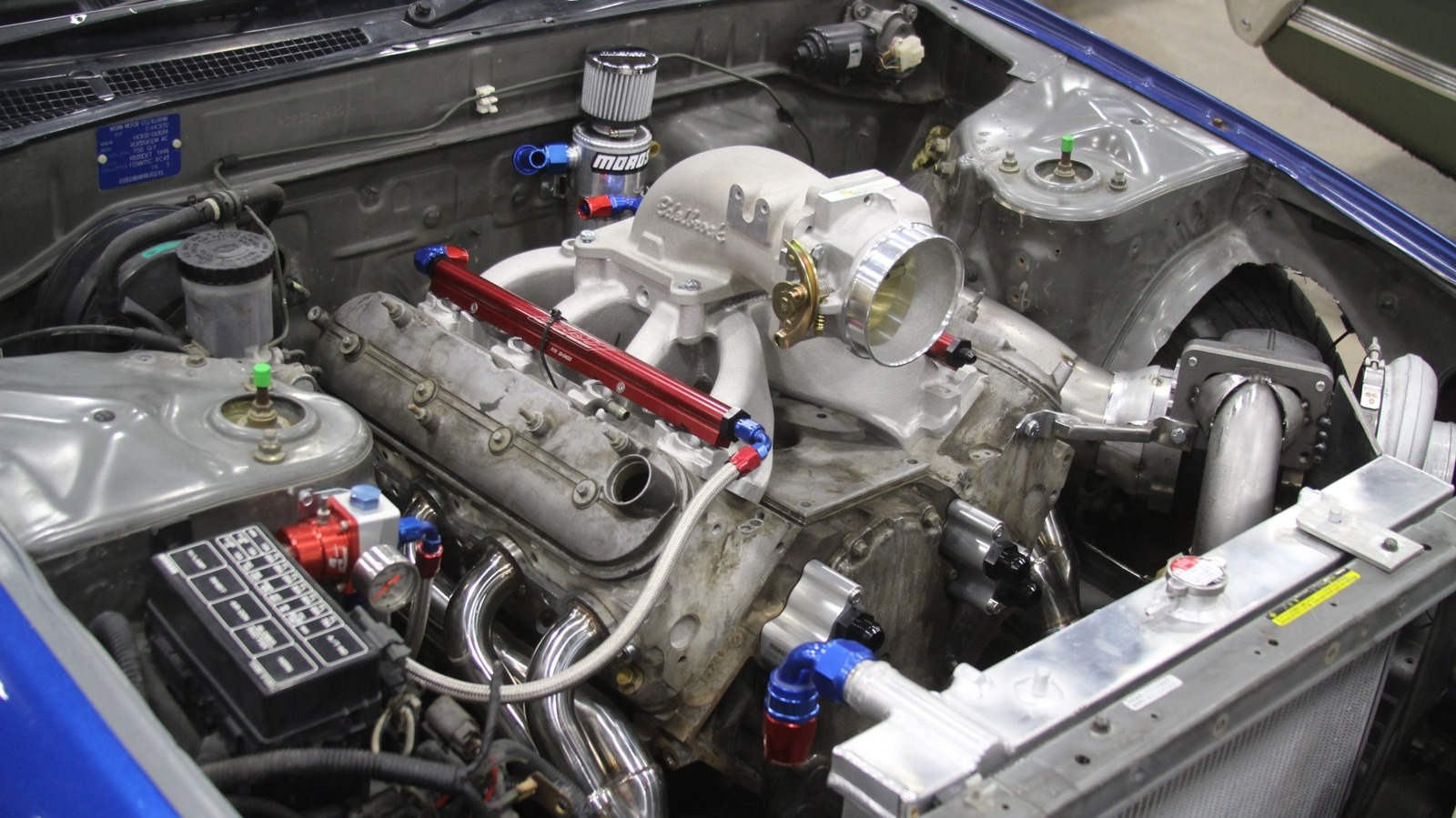
The LS in any iteration is a strong base for a performance build. 15 years ago, Hot Rod famously turbocharged a stock-bottom-end 4.8-liter to 1,200 horsepower. Part of the reason for the resilience of that poor 4.8 is that LS engines have six-bolt main bearing caps. The main caps help secure the crankshaft in the block, so, generally speaking, the more bolts that hold the caps, the stronger the bottom end. And it’s not just the bottom end. The LS has a valve train that is capable of revving to 7,000 rpm from the factory.
Dodge Viper V10
When the Dodge Viper came out in 1992, there was nothing quite like it. It was a 400-horsepower missile that was the the closest thing to a modern Shelby Cobra. The secret to the Viper’s prodigious power? An all-aluminum 8.0-liter V10. Lamborghini, a subsidiary of Chrysler at the time, helped design the V10’s aluminum block. Displacement and power figures of the V10 grew throughout the years, with the final Viper ACRs displacing a staggering 8.4 liters and outputting 645 horsepower.
As exotic as an all-aluminum V10 sounds, the Viper engine is known for its reliability, unlike some of the fussy mills in its Italian supercar counterparts. That’s not surprising, given the Viper V10 is based on Mopar’s LA series V8s. Like the LA engines, the Viper’s power plant has two valves per cylinder that are actuated by pushrods. In other words, the engine’s architecture is about as simple as it gets.
At more-than-factory horsepower, some Viper V10s are better than others. The V10s built prior to 2000 have forged pistons, which are better able to withstand the stresses from forced induction. Forged pistons didn’t reappear until the last generation Viper (2013 to 2017) was blessed with them again. Regardless of which engine you have, suppliers like D.S.S. Racing will be happy to sell you forged pistons that will hold up to boost.
