

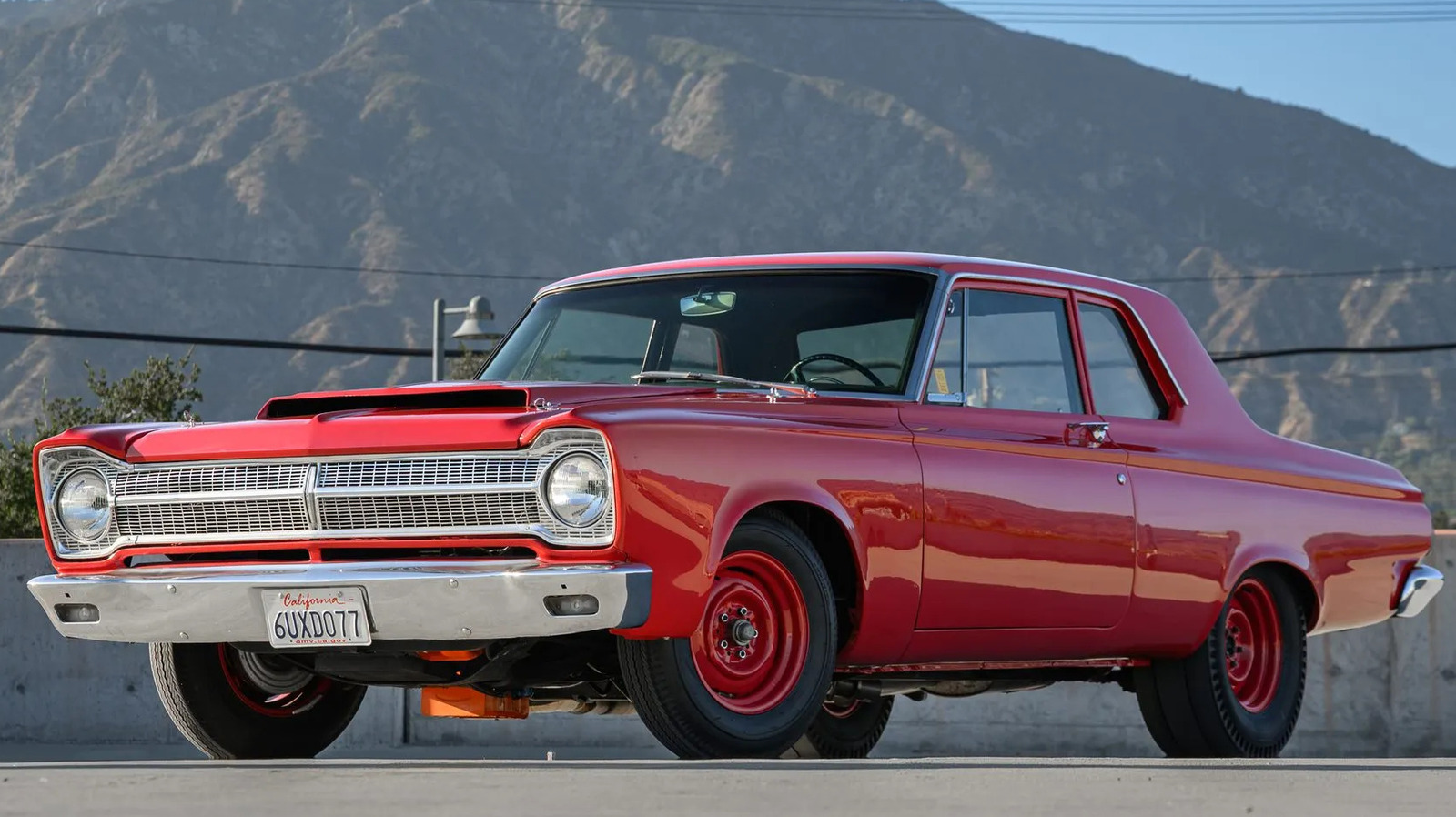
Like a lot of cars on Bring a Trailer, this 1965 Plymouth Belvedere I has been for sale on the site before. It’s up for bid on Bring a Trailer again, but back in 2020 it was bid up to $26,500 without meeting its reserve. According to the present listing, the car was sold privately in 2023. It was modified before 2010 to have a bored 588-cubic-inch Hemi with dual four-barrel Holley carbs.
That engine swap is said to be in tribute to what this car is not — an original A990 Belvedere. Those were limited-run, extra-lightweight stock racer factory builds designed for the capability of a drag car, but legal for the street. According to Hagerty, although the A990s had street-legal accoutrements such as turn signals and mufflers, they also came with a warning label inside their glove compartments that read: “This model is intended for use in supervised acceleration trials and is not intended for highway or general passenger car use.”
The thing is, the Bring a Trailer car may be special, but the 9.6-liter V8 stuffed beneath its fiberglass hood isn’t what the A990s ran, even paired with a period-correct Torqueflite three-speed automatic. Coronet and Plymouth Belvedere A990 sedans had 426-cubic-inch Hemi engines. They also got aluminum heads and higher compression. At least the dual four-barrel Holleys on the BaT car emulate what the A990s got. Still, this hat-tip-to-history Belvedere is unique, thanks to a litany of mods we’ll partially tabulate here.
A big engine made bigger
The Belvedere didn’t make our cut of nine classic Plymouth models and what they’re worth today. Nor is it as fully formed a creation as the later GTX, which we called a “gentleman’s muscle car” that expertly combined luxury and performance. Probably, if you want this Belvedere, you don’t care about any of that. You’re here for the vibes and the output.
Which is dandy, because according to the listing, a former NASCAR engine builder both bored and stroked the engine using an Indy cylinder-head stroker kit to achieve the larger displacement. So they started with the right 426 block (even if it’s not original to this car), then modified it. And you probably wouldn’t want the original motor, since it was a pretty pedestrian 225-cubic-inch Slant Six. These were ubiquitous, if not special, oddly tilted engines that refused to die. Anyway, boring the 426 to 588 cubic inches is an historically honest process of chasing power and less weird than, say, adding a turbo.
If you study the 2020 Bring a Trailer listing and compare it to the present one, you can see that the current owner has tried to push the Belvedere in a slightly more historically accurate direction. For instance, they swapped American Racing Torq Thrust D wheels with BFGoodrich Radial T/A tires for body-color 15-inch steel wheels. The latter are shod with Firestone Deluxe Champion front tires and 255/70 piecrust rear slicks. (If they’d made a meaningful performance upgrade, it might have been to swap the manual front disc and rear drum brakes, but these remain.)
It won’t sell for cheap
Actual A990 cars saw not only up to 425 horsepower, but significant efforts by the factory to reduce weight. Chyrsler cut fat from the body, using only thin-gauge steel, and the cabin had no rear seat, with only a pair of buckets up front (without headrests). This BaT Belvedere, paying proper homage, doesn’t have a radio or a heater, as was the case for A990s.
If you’re considering a purchase, know that the listing states that the odometer no longer works. Even though this six-decade-old Belvedere has supposedly logged 81,000 miles, that’s probably incorrect. The listing also notes oil leaks, and you can see in the photos that the car was partially but not entirely repainted, with the roof and driver-side quarter panel getting stripping and retouching. Photos of that process look like the shop that did this work was thorough, but ideally you’d see the entire car get that treatment. This isn’t the car’s original hue, either; it was born wearing dark turquoise metallic paint with a tan-painted cabin.
The current owner made some mechanical upgrades worth mentioning, too, replacing the fuel pump, switching to a factory-style fuel tank behind the rear axle, and moving the battery to the trunk. Does any of that matter if you lust after this monster? Probably not. Just note that original A990s have sold for as high as $200,000, which is extraordinary when you consider the inflation-adjusted sticker price of $4,500 should amount to maybe $50,000. But this isn’t an actual A990. Which is probably a good thing, since you can think of it as a car. Not an investment. And burn rubber, as nature, and Plymouth, intended.
