

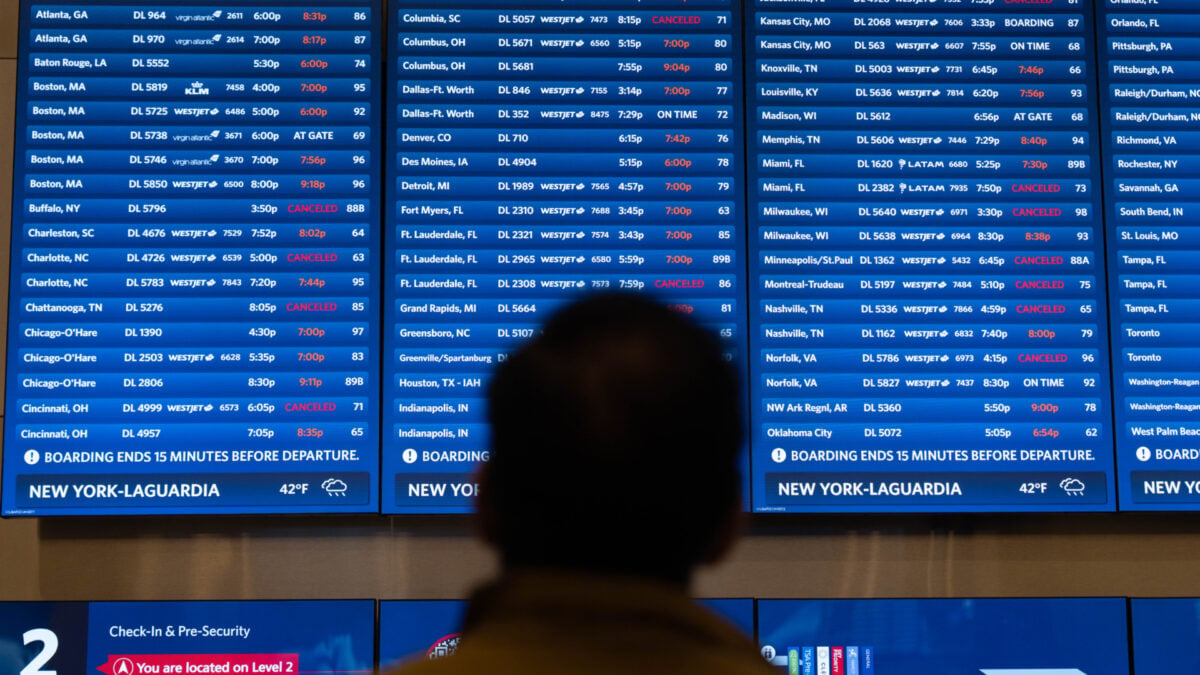
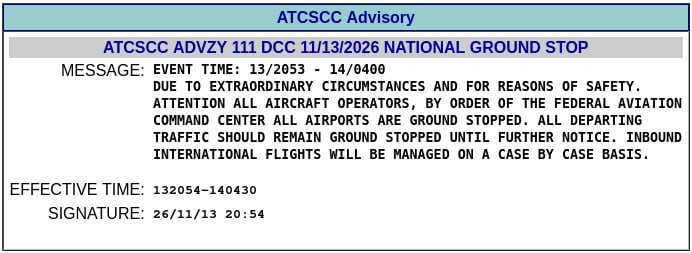
The Federal Aviation Administration has lifted a nationwide ground stop for all departing flights issued earlier Friday “due to extraordinary circumstances and for reasons of safety.”
After hours of confusion, Secretary of Transportation Sean Duffy and Department of Homeland Security chief Markwayne Mullin explained in a press conference at 8:30 p.m. ET on Friday evening that ground stop was due to the crash of outdated FAA telecommunications equipment that was undergoing upgrades. A blanket ground stop had been lifted as of 8:15 p.m. ET, Duffy said, to allow for critical air traffic to begin, although the vast majority of U.S. air travel was still snarled on the ground.
While a complete stop might be over, it’s not clear when delayed flights might actually start to take off again. Travelers remained stranded in airports well after 10:00 p.m. ET on Friday, with no solid guarantees as to when they might move.
“Everybody is safe”
Mullin assured the public there was no evidence that the ground stop was triggered by a cyber attack or artificial intelligence, and specifically said it had no connection to the massive Microsoft outage on Thursday. Duffy, however, struck an angry tone, blamed a lack of funding from Congress, and most astonishingly warned that the issue would occur again if the status quo didn’t change, even as questions remained about what exactly was happening with the FAA’s technology and whether the incident was preventable.
Duffy said that “analog telecom” had crashed and could not be immediately restored, dovetailing with previous reports that service outages had struck several Air Route Traffic Control Centers, FAA facilities which route high-altitude air traffic and play a different role than the ATC (air traffic control) centers at the nation’s airports. Wired reported the most likely candidate was the FAA Telecommunications Infrastructure, or FTI network, an ageing communications backbone that the FAA has been upgrading to fiber optic for years.
“Our switches, our routers actually got overloaded with data,” Duffy said. “And they went down. And I shouldn’t say they went down, they started to give us inconsistency in the data from those routers, and because of that we shut the system down.”
Later, Duffy said the crash resulted in “intermittent communication and intermittent radar, which is why we then shut the airspace down,” adding that all planes had landed safely: “When you have issues and you can’t immediately communicate and immediately see where aircraft are at, that’s a risk.”
Mullin said officials were “looking at” the possibility of a cyber attack and “not ruling out anything,” but seemed to suggest that the actual immediate trigger of the hardware malfunction was related to an upgrade installed by Duffy and FAA officials.
“What it appears to be right now is, as Secretary Duffy and [the] FAA was going in and putting patches into the system, they were putting new equipment and new technology, and that new equipment, new technology just wasn’t—it was overwhelming the older system,” Mullin said. He added that’s “why Secretary Duffy made it very clear, the patchwork doesn’t work.”
Duffy repeatedly steered the focus to funding for aviation operations and safety upgrades, asking, “How many times does this have to happen before Congress gives the money to fix it?” He also noted that the newer digital IP switches being installed by the FAA had not crashed.
However, in response to a question on the connection between the aforementioned upgrades and the system crash, Duffy responded, “I didn’t anticipate that we would have an outage like this.”
“The systems that were deployed kept everybody safe, everyone landed. We’re able to review what went wrong and then reboot the system and go,” he stated.
Duffy specifically denied that the outage had anything to do with SMART, the FAA’s new AI-powered system for re-routing flights that was recently implemented ahead of schedule.
“There’s no possible way” that SMART could have interacted with systems in question, Duffy said.
“FAA technicians are investigating the issue”
The ground stop was first issued at 3:54 p.m. ET, according to the Air Traffic Control System Command Center. The website where the FAA posts alerts appeared to be working only intermittently.
A spokesperson for the Port Authority of New York and New Jersey had also told Gizmodo early Friday evening that the agency was referring all questions to the FAA, and that they did not know if planes were taking off at John F. Kennedy International Airport.
A Fox News reporter, Bill Melugin, tweeted at 7:00 p.m. ET that a colleague had learned all Delta flights out of La Guardia Airport tonight have been canceled. Amtrak’s customer support feed on X was filled with posts of the rail service apologizing for high call volume and strain on their website, which certainly seems to indicate an avalanche of travelers looking for any other way home.
The Air Current, an aviation industry news site, reported that airlines have been instructing passengers to stay home “with little indication when the ground stop would be lifted and normal operations would resume.” The site noted that extensive disruption is “likely to continue” for a while due to the complexity of the nation’s air traffic routes, airports overflowing with planes, and laws that limit the number of consecutive hours that flight and cabin crews can spend working.
The delay was so abrupt and total, the Associated Press reported, that it could threaten to delay or cancel many of this weekend’s NBA, NHL, and college sports matches. Teams are reportedly either stuck in their home cities or stranded mid-season across the country, though some may be able to travel via bus.
Another casualty? Cargo flights. Air cargo basically stalled out on Friday evening, and FedEx announced it would activate contingency plans, the Associated Press reported.
National Weather Service not facing problems
The ground stop has caused people to be on heightened alert, especially given other recent tech failures. Microsoft experienced a major outage Thursday that poured into Friday.
Reuters reported that the National Weather Service was experiencing nationwide internet and communications problems on Friday. Some social media users also reported that NWS was suffering a radar outage, but none of that seemed to be true.
A spokesperson at the Baltimore/Washington forecast office of the National Weather Service told Gizmodo via phone that they weren’t encountering any problem with radar, and could see live updates from other field offices. Gizmodo called NWS back around an hour later, after CNN had also reported there was an outage. The spokesperson again confirmed their office was receiving radar updates and they hadn’t noticed any IT issues.
“I just saw it on national news and was like ‘where is this coming from?’” the spokesperson said after checking for updates.
The rumor about an outage appeared to be based on an outdated page specific to Anchorage, Alaska. The Internet Archive’s Wayback Machine shows that the page has been active for years and isn’t related to a current radar outage. It’s unclear if the Reuters reporting relied on the old web notice or if the news outlet spoke to NWS directly.
The NWS stated radar and their website “is fully operational” on X just before 6:15 p.m. ET.
Where’s the president?
President Trump has posted to Truth Social twice since the national ground stop was issued, but neither post addressed the national air emergency. One of the posts was about working on tax incentives for Hollywood, and the other was about the Coast Guard rescuing people when ships collided in Louisiana today.
This is a breaking news story and will be updated.
