

Like it or not, building a performance SUV is almost an obligatory part of being an exotic car manufacturer right now. Pretty much every major supercar brand has one. Even McLaren, which once swore that it would never make an SUV, is officially working on an SUV. They’re huge when it comes to helping these brands keep the lights on, and still usually really flippin’ fast.
In a straight line from a dead stop, most aren’t that far off from their “real” supercar stablemates. Furthermore, in the case of new, four-digit horsepower, all-electric ones, they might even beat some actual supercars to the finish line. We’ve assembled five of today’s best and most notable exotic SUVs from brands like Ferrari, Lamborghini, and Porsche, ranking them by pure horsepower. And guess what? There’s a trend that, appropriately perhaps, purists are going to absolutely hate: The fewer cylinders there are, the more power there is.
5. Ferrari Purosangue: 715 HP
Case in point: the Ferrari Purosangue is simultaneously the SUV on this list with the most cylinders and the one that makes the least power. We let that slide on sheer charisma, though, because what it’s working with is a naturally aspirated 6.5-liter V12 — no turbos, no hybrid motors, just 12 cylinders of practical Italian fury.
It is weirdly one of only two cars in Ferrari’s lineup that still uses a V12 (the other is the 12Cilindri grand tourer), but its mere 715 horses puts it on the back foot in terms of power compared to pretty much all of its chief competitors. That said, it’s likely the best-sounding car of this group, having a redline of 8,250 rpm. Ferrari quotes a zero-to-62 mph time of 3.3 seconds and a top speed over 193 mph. It gets coach doors (the rears open backward) and starts at around $440,000.
4. Aston Martin DBX S: 717 HP
Coming in above the Ferrari in terms of horsepower by the thinnest of margins is the 717-hp Aston Martin DBX S. The most powerful variant (so far) of Aston’s SUV makes 20 more mechanical hp than the 697-hp DBX707 (the number in that car’s name referred to metric hp, not mechanical), while weighing almost 104 pounds less thanks in part to a center-of-gravity-lowering carbon fiber roof.
That power comes from a 4.0-liter twin-turbo V8 borrowed from Mercedes-AMG, although Aston says some turbo tech, such as the bigger compressor wheel diameters, are taken from its own Valhalla supercar. Zero to 62 mph takes 3.3 seconds, and it tops out at 193, which are both identical to the Purosangue. Coincidence? Highly unlikely. When we drove it last year, we wrote that it “might be the best-driving SUV on sale.” The DBX S starts at $274,500, but considering the one we tested had a final invoice of more than 400 grand, “starting prices” are sort of academic in this neighborhood of the market.
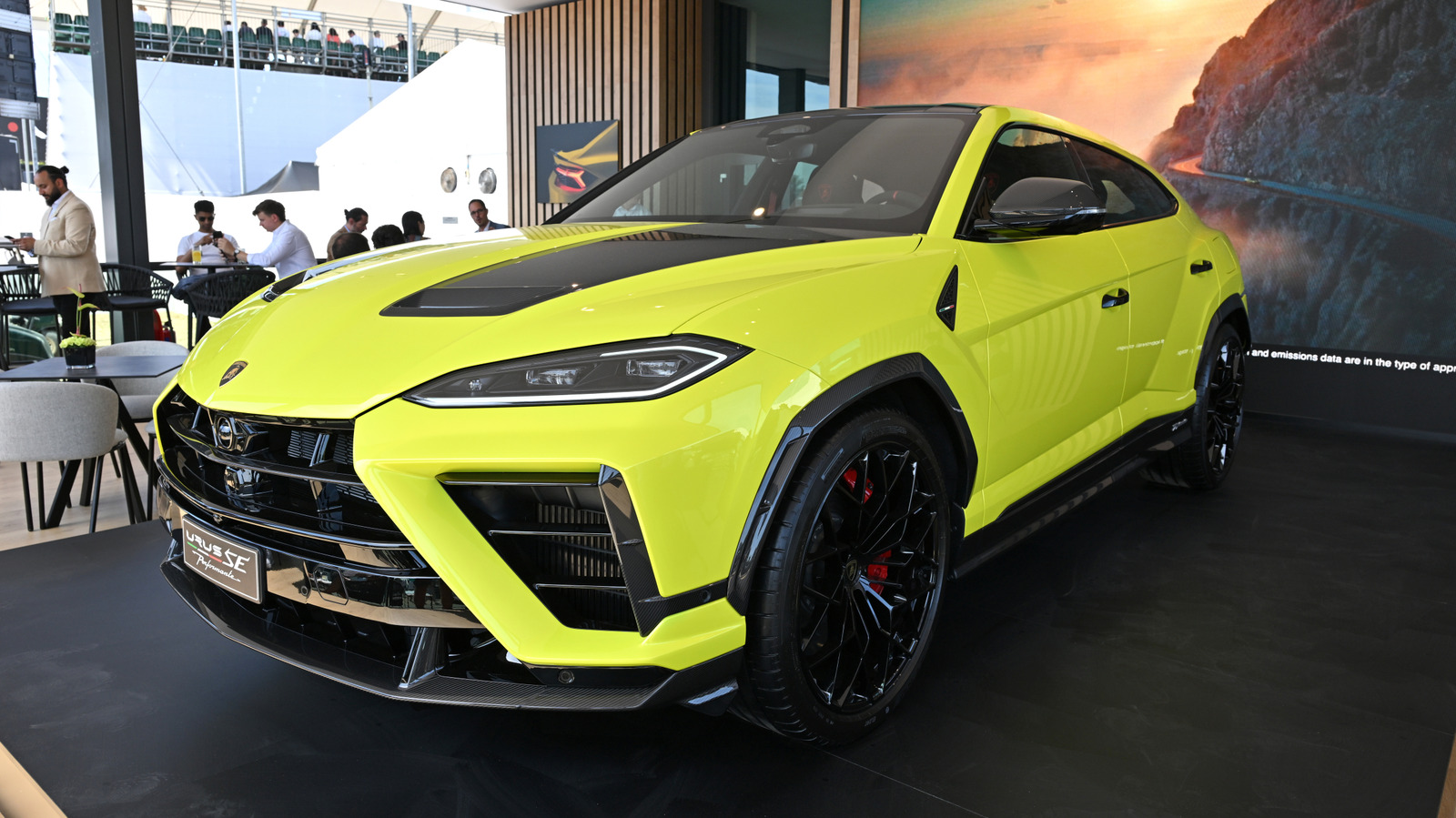
3. Lamborghini Urus SE Performante: 801 HP
Given Audi’s ownership of Lamborghini, it’s perhaps not surprising that the first electrified entry on this list is the Urus SE Performante. Those familiar with Lambo nomenclature will already know that this is the pumped-up version of the plug-in hybrid version of the brand’s very popular SUV. Like the Aston Martin DBX, this car uses a 4.0-liter twin-turbo V8, albeit borrowed and adapted from its parent company, Audi. The SE part of the equation adds a hybrid electric motor that results in a total of 801 horsepower.
Comically, however, it’s not any quicker than its un-electrified rivals and just barely faster than its Aston Martin counterpart. Electricity is mighty, but also heavy. Zero to 62 mph takes 3.3 seconds (exactly the same as the DBX S and Purosangue). In comparison, the Urus SE Performante’s 312 km/h (194 mph rounded) top speed is one mile higher than the DBX S’ 193 mph, but Ferrari is more vague with reporting the Purosangue’s top speed, simply listing the SUV as capable of exceeding 310k m/h (193 mph rounded). The Urus SE Performante’s starting price has not yet been confirmed.
2. Porsche Cayenne Turbo Electric: 1,139 HP
When it comes to raw horsepower and speed, though, gas-powered entries are sort of fighting for silver these days because all-electric offerings like the Porsche Cayenne Turbo Electric are putting out horsepower figures with commas in ’em. This specific Porsche makes 1,139 horsepower from two electric motors. Zero to 60 mph takes 2.4 seconds (almost an entire second quicker than its gas rivals), but top speed is just 162 mph (more than 30 mph down from internal combustion), which speaks to what performance EVs are good at and what they aren’t. The electric Cayenne Turbo features nifty side aeroblades that deploy outward to reduce drag.
In the more exotic-looking Coupe form, this car starts at $170,350, magnitudes less than the other vehicles we’ve seen so far, but that likely speaks more to the Porsche’s “exoticness” than abilities. To those who question whether Porsche even qualifies as an “exotic” automaker, though: if a 1,139-hp car with moving sideblades and optional gold wheels isn’t an “exotic SUV,” I don’t know what is.
1. Mercedes-AMG GT 63 SUV: 1,153 HP
In a similar vein, if the Urus with its VW Touareg underpinnings is obviously an exotic SUV, then the new Mercedes-AMG GT 63 SUV and its relation to cars like the old GT Black Series should count, too. It definitely counts on accelerative merit: three axial flux electric motors drawing energy from a Formula 1-derived 800-volt battery deliver 1,153 horsepower. Zero to 60 takes 2.4 seconds with a one-foot rollout and 2.6 seconds without. Top speed stands at an electronically limited 168 mph, precisely 6 mph faster than the Porsche but still not in the same time zone as the 190-plus mph gas rivals.
The AMG GT SUV is one of those electric performance cars that mimics the sound of a gas car engine — specifically an AMG V8 — with simulated gear shifts and corresponding seat vibrations also present. As of this writing, the electric AMG GT SUV is too new for us to have driven it yet, but we recently had a go in the sedan and found it mind-blowingly good. The SUV, then, shouldn’t be far behind. Mercedes-AMG’s GT SUV pricing has not yet been confirmed for the U.S.
