
In 1971, a minor player in the American automotive industry accomplished something extraordinary. After years of long-shot competition against companies with vastly more significant resources, American Motors Corporation won the Trans-Am championship. The following year, it did it again.
The upstart AMC had been building cars in Wisconsin, across Lake Michigan from the Detroit giants that the company would later beat at their own game. Yet, not long after the metaphorical credits would have rolled following that fairytale ending, the car responsible for those victories would be no more. The car was the AMC Javelin, and by the end of 1974, it was gone.
It’s tempting to tell the Javelin’s story as one of failure, mostly because that’s how we tend to remember the cars that don’t survive long enough to earn a prominent place in our shared automotive history. The icons become institutions, celebrated and remixed into anniversary editions, nostalgic ad campaigns, and generations of increasingly expensive collectibles. Everything else is a footnote.
But the Javelin’s existence has more to say than the handful of years in which it was made, as its brief run coincided remarkably with a transformative shift in the broader history of the automobile in the United States. It arrived in 1968, when American prosperity seemed limitless, and disappeared just as the country was beginning to confront the limits of that optimism.
Along the way, the Javelin became something its creators could have scarcely imagined. Its story is one of ambition, ingenuity, and the kind of underdog triumph that’s impossible not to root for. Except, it’s also about the difference between reaching a dream and being able to hang onto it.
America falls in love with the pony car
In the early ’60s, the American automobile was clearly becoming more than just a way to get around. The baby boomers were getting old enough to drive, and cars weren’t just for families anymore. Women took to the road in increasing numbers, and multi-car households became more common. As a growing market with more disposable income showed an appetite for cars that were more fun and even had a little personality, carmakers were eager to oblige.
Ford led the way. The company introduced the Mustang at the New York World’s Fair on April 17, 1964. The Mustang had a long hood and short rear deck that fundamentally changed the posture of what a fun car could be and started at just $2,368. Available options and configurations could accommodate buyers interested in anything from a free-spirited runabout to a serious performance car.
Ford expected to sell 100,000 Mustangs a year. It took 22,000 orders on the first day, and first-year sales exceeded 400,000 cars. The era of the American pony car had arrived, but that meant more than just the Mustang.
Plymouth had actually beaten Ford to market with the Barracuda, but Ford gets the credit for turning the segment into a sensation. Chevy answered with the Camaro, Pontiac arrived with the Firebird, and the Mercury-branded Cougar followed its Ford sibling into production.
The pony car offered buyers individuality, excitement, and an invitation to have fun with cars in ways that went beyond simply buying a family sedan with a needlessly-large V8. American Motors didn’t have one.
The Javelin earns its place among the pony cars
American Motors Corporation built a reputation around economical, everyday cars since the company was established by a merger of the Nash-Kelvinator Corporation and the Hudson Motor Car Company, which, in 1954, represented the largest merger in United States history. As America embraced the fun, new Mustang and its early pony car contemporaries, AMC was struggling with a stodgy and decidedly unexciting reputation.
Enter the 1968 Javelin, a sporty coupe developed under AMC design chief Richard Teague after he had personally advocated for AMC to get in on the pony car segment and start shaking off the buttoned-down, no-fun image. The car had a long hood and daring proportions that clearly made a play at the burgeoning market without being a copy of any that existed so far. In-period advertising called out the Mustang by name, leaning into the rivalry and calling out the Javelin’s differentiating features like large, contoured bumpers, hand-finished roof joints, and extra room inside.
Underpinning what some would say is one of the most attractive muscle cars ever forgotten was the basic architecture of AMC’s Rambler American, a car that was explicitly built to minimize operating costs and compete with the rise of economical imports. Yet, AMC was able to take the bones of one of the least exciting vehicles on the road at the time and use it as a jumping-off point that could do more than turn heads. Engine choices included a 232-cubic-inch inline-6, 290 and 343 V8s, and, eventually, a 390-cubic-inch V8 producing 315 gross horsepower. A 390-powered Javelin SST tested by Car and Driver reached 60 mph in 6.9 seconds.
People noticed. AMC had first set out to sell just 35,000 Javelins but ended up building more than 50,000 in that first year.
AMC discovers the freedom of being different
The Mustang might have been leading the herd when it came to pony cars, but AMC wasn’t content to spend the Javelin’s existence playing catch up and running ads touting its superior headroom or trunk space. Even if the company couldn’t compete with Detroit’s marketing or development budgets, it could at least try to out weird the competition.
For 1969, AMC introduced its “Big Bad” paint colors: Big Bad Blue, Big Bad Green, and Big Bad Orange. These were absolutely eye-piercing finishes that came with body-colored bumpers and complementary hardware options like (fake) exhaust shields, stainless steel trim, and a roof-mounted spoiler. Unlike almost everything AMC had produced up until that time, subtlety was not part of the package (and it remains one of the classic coupes that looks sick with window louvers).
In 1970, the company doubled down, with 100 Javelin SSTs built as replicas of the cars in the Trans-Am racing series, finished in the over-the-top red, white, and blue livery of AMC’s competition cars. There was not a unique high-performance engine under the hood, and the replicas came with the same 390-cubic-inch V8 available on the SST. So, aside from a ram-air hood and performance-oriented gearing, this was a car that was all about appearances.
That appearance was spectacular to be sure, though some of those 100 Trans-Am replicas ended up being repainted back into submission, presumably because drivers were getting more attention on the street than they bargained for. All that said, AMC saw that the Javelin had the potential to be a lot more than just a pony car dressed up like a race car. It was headed to the races, and the company had every intention of winning.
The underdog goes racing against Detroit
Of course, there’s a difference between having the willingness to sell customers a replica race car from the factory and actually competing on the track. Perhaps the likes of Ford and Chevrolet represented immovable racing incumbents, but AMC wasn’t going to concede the point.
In 1967, the company commissioned Ronnie Kaplan Engineering to prepare a handful of Javelins for the Sports Car Club of America’s Trans-Am series, which included Mustangs and Camaros backed by Big Three resources and some of the best drivers in the world. The Javelins were powered by modified versions of AMC’s existing V8s, bored out from a factory-stock 290-cubic-inches up to just over 304, but they were still no match for the competition in a straight line.
Despite the horsepower handicap, drivers Pete Revson and George Follmer drove AMC to six second-place finishes and landed third overall in the 1968 manufacturers’ championship. It was a promising start, but the team remained a distant third behind the two well-funded factory-backed teams of Chevy and Ford. The following year, Kaplan’s team failed to maintain the momentum and the series was roundly dominated by Penske Racing and its driver, Mark Donohue, driving for Chevrolet.
AMC had demonstrated that it could compete on the racetrack, but the little red, white, and blue Javelin had gone two seasons without a victory. It would have to do something differently if the company wanted a real shot at beating Ford and Chevy at their own game.
Roger Penske and Mark Donohue change everything
Penske and Donohue were two people who had just spent consecutive racing seasons beating up on AMC and its Javelin, but it turns out that they were also something else: free agents. Fresh off of delivering back-to-back manufacturers’ championships for Chevrolet, the pair agreed to revise loyalties and see what they could do with the upstart Javelin. Donohue was anything but a mere hotshot racing driver. He had studied engineering at Brown University, and in addition to being behind the wheel, he was also team manager and chief engineer. Together, Penske and Donohue took to the engineering side of the problem first, starting out by questioning the Javelin’s bored-out V8. What if instead of stretching AMC’s 290 to the limit, they started with the company’s newer 360 V8, reducing its stroke to meet the series’ displacement limit while producing enough horsepower to challenge Chevrolet?
Winning is what happened. Donohue drove the Javelin to the car’s first three first-place finishes in 1970, and, for the first time, AMC managed to pick off one of its two big factory rivals, pushing past Chevrolet and finishing second behind Ford. The Javelin wasn’t just an oddball outsider hoping to deliver the occasional upset to establishment rivals. It was a serious car capable of winning against the best Detroit had to offer.
The Javelin becomes bigger, bolder, and more ambitious
Of course, while Donohue and Penske were out winning races, AMC also had to continue being a company that makes and sells cars. For 1971, AMC released a substantially redesigned Javelin that was longer, lower, wider, and more visually striking. Bulging front fenders caught the public’s eye, not to mention that of Donohue, who appreciated the breathing room the new design would give to race tires on his Trans-Am cars.
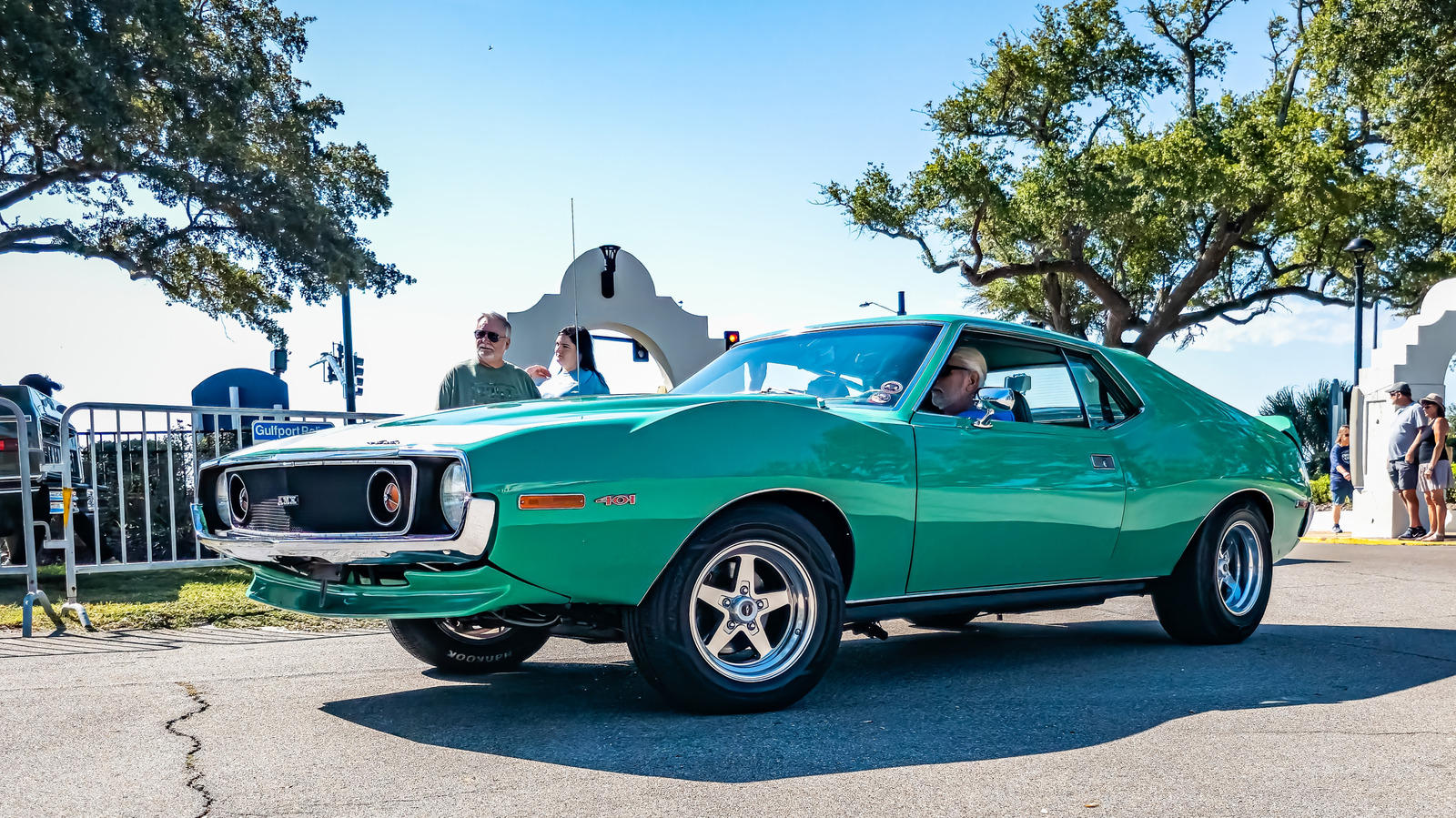
It was here that the AMC AMX shifted from its previous status as its own model in the AMC lineup, becoming a trim package for the up-and-coming Javelin. This new Javelin AMX could then be equipped with AMC’s 401-cubic-inch V8, rated at 330 gross horsepower. And yet, somehow, this was just the beginning. The following year, AMC tapped fashion designer Pierre Cardin for an outrageous aesthetic overhaul that included colorful stripes taking over the interior, and, indeed, what was once the most conservative automaker was now creating the wildest muscle car graphics in the business. Along the way it built one of the era’s automotive special editions that was truly special.
People were taking notice, including the Alabama State Police, which placed an order for 100 of the 401-powered Javelins for use as cruisers. The Javelin had finally helped AMC shrug off its dull reputation as the company that brought America the Rambler.
AMC finally does the impossible on the racetrack
In 1971, American Motors finally reached the goal it’d been chasing since the Javelin started racing. Mark Donohue won seven of that season’s 10 Trans-Am races and delivered AMC’s first manufacturers’ championship. The company that had gotten its start building painfully sensible transportation had finally conquered one of America’s most prestigious racing series. The following year, Roy Woods Racing took over the AMC effort, with George Follmer winning four races, becoming the first officially recognized driver’s champion of the series, and bringing home the manufacturers’ championship for a second time.
After four straight years of throwing the Javelin squarely at the fiercest competition of the day, AMC had done it. But even so, this previously unthinkable victory came at a time when the foundation of the Trans-Am series was beginning to shift. Other manufacturers, Ford and Chevy included, had withdrawn factory support for the Trans-Am series the year before. They were still on the racetrack, but without the intense backing that had pushed the teams forward through previous seasons. Still, AMC was up against some of the fastest cars that the most formidable manufacturers had fielded the previous season, and some of the private teams were anything but amateurs -– it was the private Penske team that brought Chevrolet those back-to-back championships in the first place, after all.
The Javelin had reached the top. A team of engineers, drivers, and ambitious company people had turned the unlikely descendant of the Rambler into a championship-winning machine. The achievement was nothing short of extraordinary, only it happened just as the mountain was beginning to empty.
America changes, and AMC changes with it
The Javelin came of age in an America where the future seemed limitless, with more horsepower, unimaginable freedom, and an endless supply of cheap gasoline to keep it all roaring forward. But while the Javelin was winning car races and AMC was experimenting with wild paint colors plus Pierre Cardin aesthetics, the country itself was starting to feel different.
The Clean Air Act of 1970 introduced ambitious new emissions requirements, effectively tapping the brakes on what made the pony car segment sing. In ’73 the oil embargo sent petroleum prices through the roof, and Americans who had never given a thought to a seemingly bottomless supply of oil were suddenly weighing what they were going to do if gas ran out. The era of giant V8s drinking fuel right from the tap with no concern for tomorrow was coming to an end.
The extraordinary irony for AMC was that the boring, practical reputation it had worked so hard to overcome was exactly what the market was starting to demand. Sensible, economical transportation was back in style, and despite years of running the other direction with the Javelin, the company was well-positioned to capitalize on the shift, with cars like the Gremlin and the Hornet ready to meet the moment. AMC had finally built a performance champion, but its greatest opportunities lay in leaving it behind.
Winning was never going to be enough
In 1971, the Javelin was taking its victory lap on the national stage. Just three years later, it would be offered for the last time. 1974 marked the end of AMC’s unlikely hero, leaving incumbent mainstays like the Mustang, Camaro, and Firebird to carry the segment forward into uncertain times.
AMC could have stayed in the game, navigating the new landscape as rivals were attempting, but the Javelin would have required significant updates to meet 1975 safety regulations, including an estimated $12 million investment in bumpers alone. The time had come to move on.
That following year, Mark Donohue crashed while practicing for the Austrian Grand Prix. He had seen the potential in AMC’s alternative pony car, joining the team to both engineer it into contention and to sit behind the wheel. Donohue died following emergency brain surgery after the wreck, and so 1975 marked the loss of both the Javelin itself and an icon who was central to what it had become.
AMC had done what it set out to do. It had built a car exciting enough for the times, challenged the biggest carmakers in the country, and won it all, twice. Yet, after all that, it would turn out that what America needed just then wasn’t a better Mustang after all. It needed a better Rambler.
