

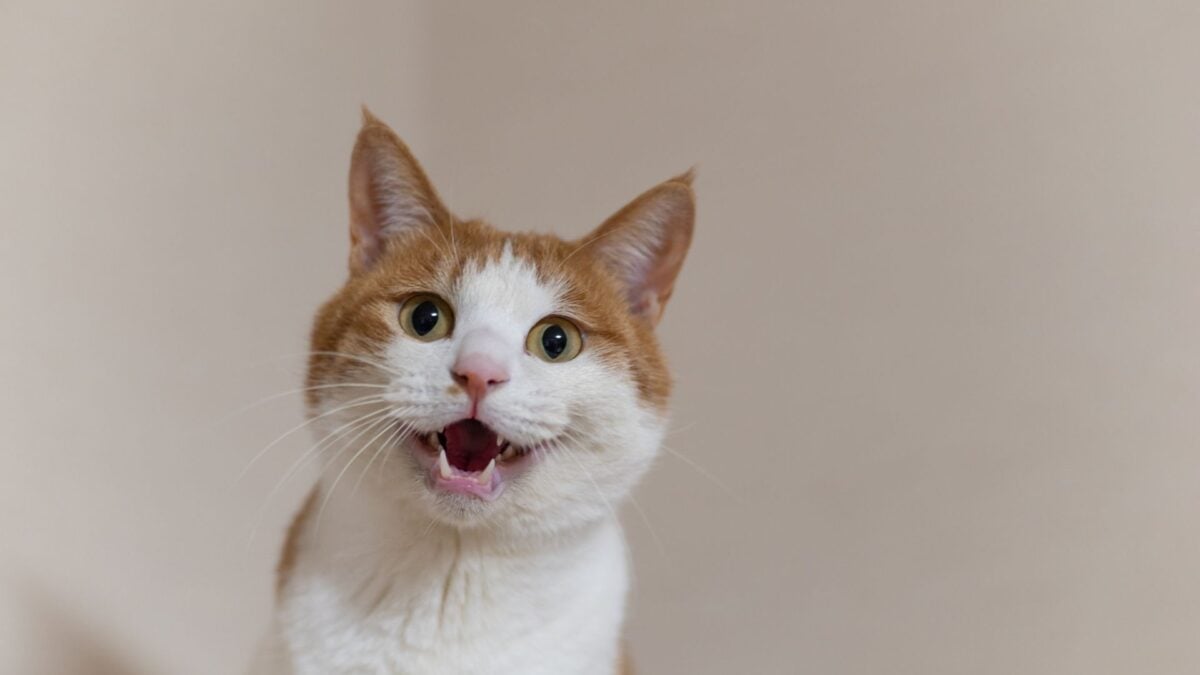
If you’ve ever owned a cat, you might have a sneaking suspicion that they see humans as their loyal servants, meant only to cater to their every whim. Recent research suggests there’s some truth to that idea.
Scientists in Brazil studied how cats behaved around treats in a box that they couldn’t get their paws on. When a person was in the room at the same time, the cats were much more likely to meow and to alternate their gaze between the person and the box, they found. The findings indicate that cats do indeed meow and use other visual cues to get a human’s attention and help when needed, the researchers said.
“These results are consistent with meowing playing a communicative role in cat–human interactions,” they wrote in their paper, published earlier this month in the journal Animal Behaviour.
The human helper
It’s well known that cats typically meow more frequently toward people than they do toward other cats. According to the researchers, however, it’s still been unclear whether cats explicitly use meowing to communicate with people. To test this hypothesis, they designed an experiment to look for the audience effect in cats—an established phenomenon in humans where we sometimes act differently when we know someone else is watching us.
Cats can be tricky research volunteers, since they often behave differently in a lab setting or around strangers than they do in their usual environment. So the researchers recruited cat owners to help conduct the experiments right at home. Overall, 38 cat-human pairs were involved in the study.
The cats were placed in a room with a box clearly containing their favorite treats that were sadly out of their reach. They were then observed under two conditions: being left alone in the room or having their human around.
When alone, the cats typically stood still and gazed at the door. But when their human was there, the cats meowed up to 16 times more frequently, usually while staring directly at the human. They also sometimes shifted their gaze between the person and the box, seemingly because they wanted the person to secure the treats for them.
The results suggest that cats also experience the audience effect, the researchers said, and that their meowing can function as a deliberate “socially directed signal” toward people.
What should this mean?
It’s worth noting that this is still a relatively small study, so ideally more research should be conducted to validate these findings. The team also used cats that were already frequent meowers, according to their owners. So it’s possible less chatty cats might more often use other behaviors than meowing to communicate with humans.
Even if these conclusions seem obvious to anyone who’s owned a cat (myself included), it’s still valuable to empirically study how cats interact with people—if only because we can’t ask them directly. And doomed as cat owners are to be at their felines’ every beck and call, it’s a trade-off that most happily accept, I wager.
We get everything our cats desire, and they give us years of company, laughs, and cuddles. Fair deal.
